

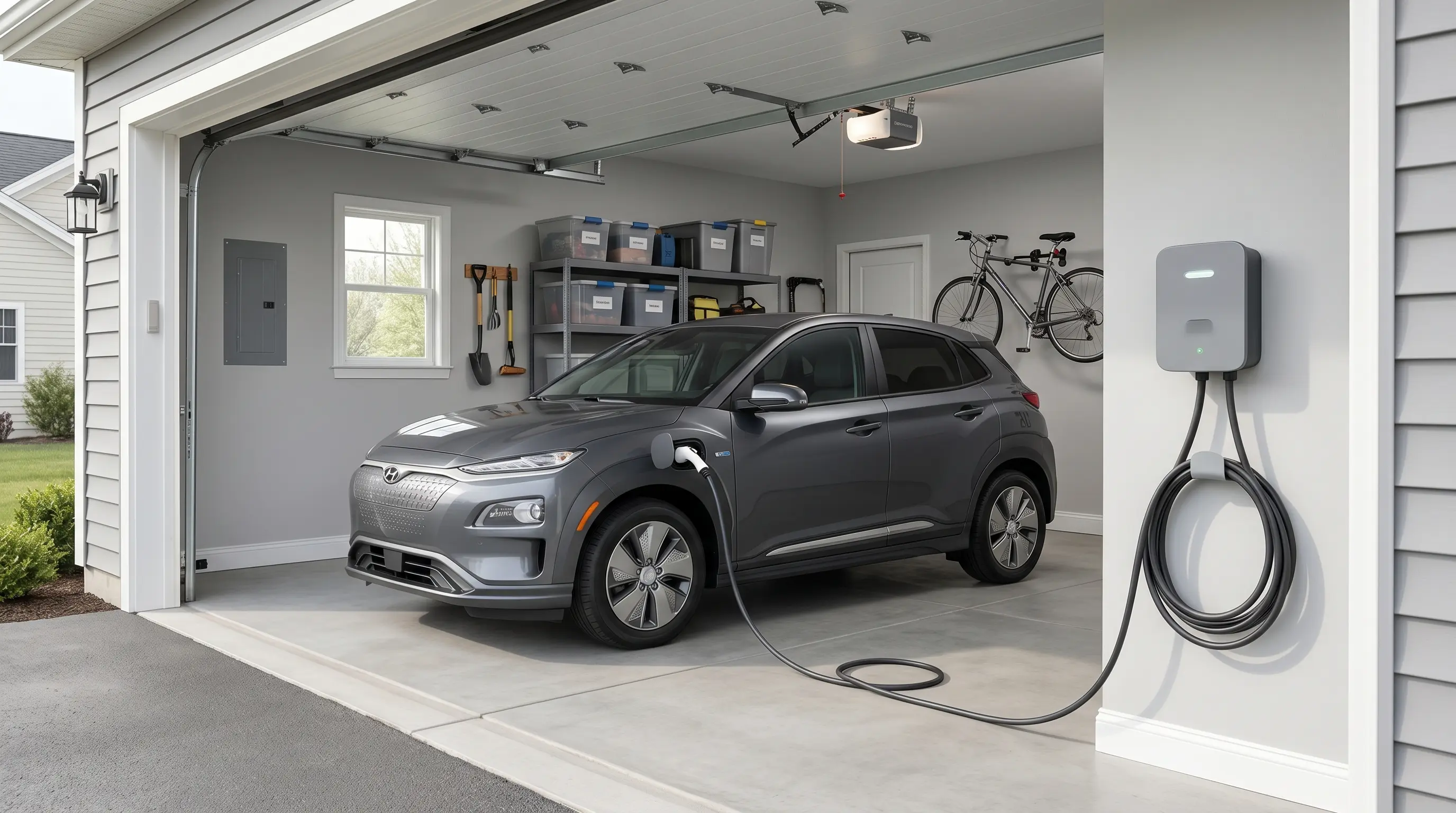
If you are thinking about installing a home EV charger in New Jersey, the first question is usually simple: do you really need one, and if so, what kind?
For most EV owners, the answer is yes. Home charging is usually the most convenient way to keep an electric vehicle charged and ready to drive. But the right setup depends on your vehicle, how much you drive, your electrical panel, and where the charger will be installed. Solar Me’s own EV charger page frames this the same way, with Level 1 and Level 2 as the main homeowner choices and Level 2 as the more practical option for most full EV drivers.
Level 1 vs. Level 2: what most homeowners actually choose
There are two practical home-charging options.
Level 1 uses a standard 120-volt outlet. It is the slowest option and usually adds about 2 to 5 miles of range per hour of charging. That can be enough for plug-in hybrids or for drivers with short daily mileage.
Level 2 uses a 240-volt circuit and dedicated charging equipment. It usually adds about 10 to 30 miles of range per hour, depending on the vehicle and charger. For most full battery EV owners, Level 2 is the more practical setup because it can recharge the car overnight much more easily. Solar Me’s own site also presents Level 2 as the step up most homeowners want for faster charging.
That is the simplest way to think about it:
- Level 1 is slower and sometimes good enough
- Level 2 is what most homeowners want if they drive a full EV regularly
What a Level 2 installation usually involves
A typical Level 2 install often includes:
- checking your electrical panel to see whether it has enough capacity
- planning the route from the panel to the charger location
- pulling the required electrical permit
- installing a dedicated 240-volt circuit
- mounting and connecting the charger
- completing inspection and approval as required locally
The exact breaker size, wire size, and installation method depend on the charger, the distance from the panel, and local code requirements. That is why a real site visit matters. Solar Me’s current EV charger service page also describes the process as a proper installed system, not just “plug something in and hope.”
What home EV charger installation costs in New Jersey
For a straightforward Level 2 installation in a home that already has enough panel capacity and a simple charger location, total cost often falls somewhere around:
- charger hardware: roughly $400 to $700
- installation, permit, and materials: often around $800 to $1,800
- typical total for a simpler install: about $1,200 to $2,500
If the project needs more work, such as a long wire run, exterior conduit, trenching, or a service-panel upgrade, the price can go much higher.
These are planning ranges, not guaranteed quotes. A proper in-home estimate is the only way to know what your house will actually need.
Do you need a panel upgrade?
Sometimes yes, sometimes no.
If your home has a modern 200-amp service panel with open capacity, adding a Level 2 charger is often much easier. Older homes with 100-amp service, crowded panels, or a lot of existing electrical demand may need extra work before a charger can be added safely.
In some cases, a load-management setup can help avoid a full service upgrade by reducing charger output when the house is drawing heavily. That can help in the right home, but it is not a universal fix. The right choice depends on your panel, your charger, and how much power the rest of the house is using.
How solar fits into the picture
Pairing EV charging with solar can make a lot of sense, but it should be explained honestly.
A home EV charger does not automatically become ultra-cheap just because you have solar. The real value depends on how much solar your system produces, when you charge the vehicle, how much of that solar energy you use directly, and what you otherwise pay the utility.
The cleaner takeaway is this:
- if you already have solar, charging at home can be more attractive
- if you are planning both solar and an EV charger, it can be smart to size the electrical work and solar design together
- solar and EV charging often complement each other well, but the exact savings depend on the house and driving habits
That lines up with Solar Me’s own service and blog messaging, which connects EV charging with home solar without pretending the savings are identical for every household.
Incentives and utility programs in New Jersey
There are a few current programs worth knowing about.
Federal charger credit
The federal Alternative Fuel Vehicle Refueling Property Credit under Section 30C can still apply to home charger installations in eligible low-income or non-urban census tracts. Not every address qualifies, so homeowners should check eligibility before counting on it. Solar Me’s own incentive page says the same thing and notes that qualifying installations are currently eligible through June 30, 2026.
Charge Up New Jersey home charger incentive
New Jersey currently says homeowners can receive up to $250 when they purchase an eligible home EV charger.
Utility programs
Some New Jersey utilities have offered EV charging incentives, off-peak credits, or charger-related programs, but the details can change and not every utility is offering the same thing at the same time. Because availability and enrollment status can shift, homeowners should check the latest program terms directly with their electric utility before counting on any rebate, bill credit, or make-ready incentive. JCP&L’s public materials are a good example of why this wording needs to stay careful.
Choosing the right charger
Some common choices homeowners may see include:
- Tesla Wall Connector
- ChargePoint Home Flex
- Emporia EV Charger
- Grizzl-E
- Wallbox Pulsar Plus
The best charger is not always the most expensive one. What matters most is:
- connector compatibility
- charging speed that fits your car and panel
- indoor or outdoor rating
- smart features you actually care about
- whether it works cleanly with your electrical setup
A charger with J1772 or NACS/J3400 support can cover most current U.S. EV use cases, depending on the vehicle and charger model.
Get it done right
A bad EV charger install is a real electrical and fire-safety issue, not just an inconvenience.
The best installs start with a real look at the panel, the route to the charger location, and the actual charging needs of the household. That is what keeps you from overbuilding, underbuilding, or getting surprised by upgrade costs halfway through the job. Solar Me’s current EV charger service page and current EV charger blog both lean into this “done right from permit to final inspection” angle, so this framing matches their site well.
Let us help you size it correctly
Solar Me can help you evaluate your panel, charger location, and driving habits so you can choose the right setup without overspending or boxing yourself into the wrong equipment.
