

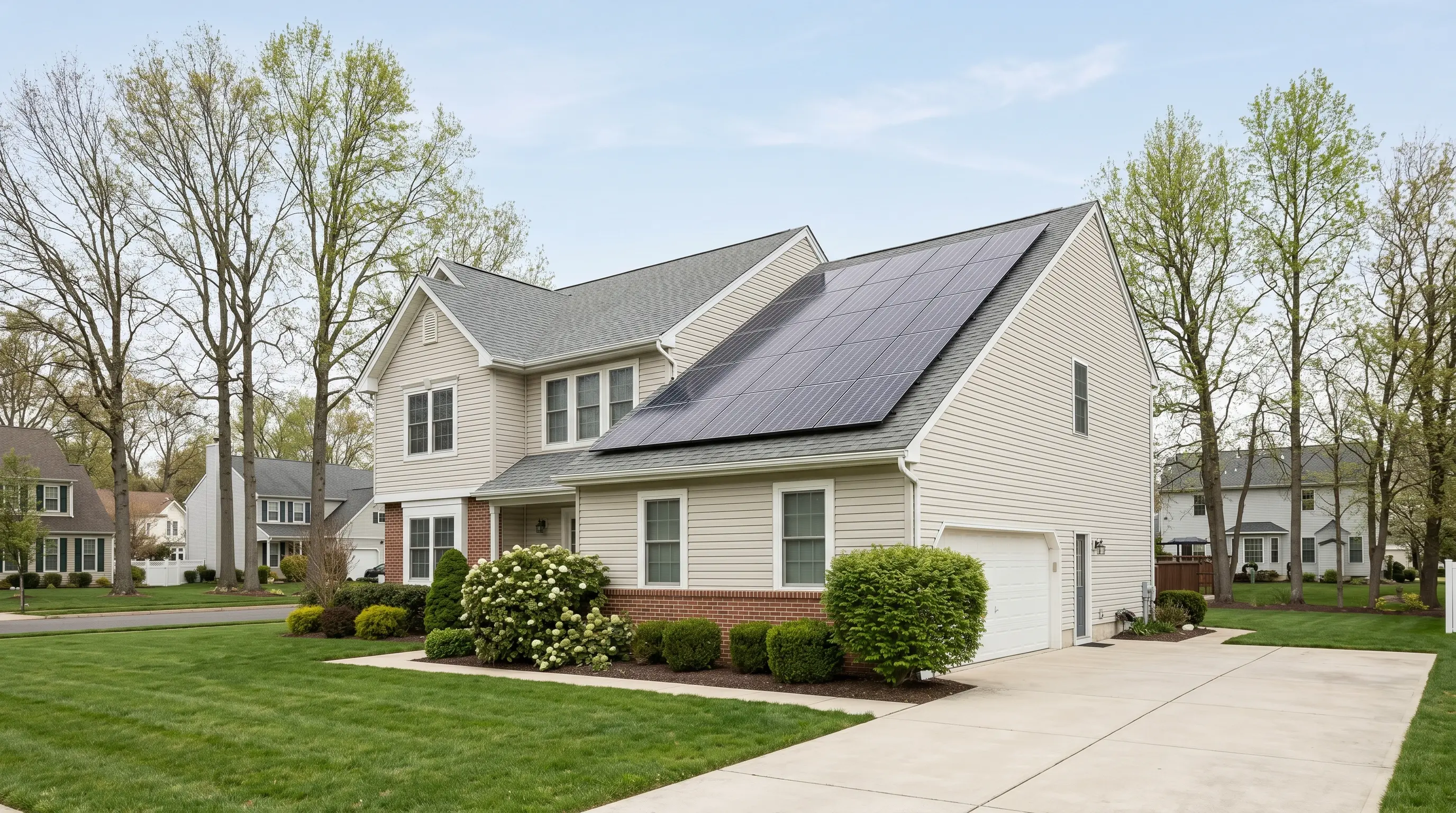
If you are pricing solar in New Jersey in 2026, the first thing to know is that the old federal residential solar tax credit is no longer available for new residential systems placed in service after December 31, 2025. That changes the math from prior years. At the same time, New Jersey still offers meaningful long-run value through ADI, net metering, and state tax treatment, which means solar can still make financial sense for many homeowners even without the old 30% federal credit.
The second thing to know is that there is no single “correct” solar price. Roof design, equipment choices, electrical work, battery storage, and local permitting can all move the number. A realistic cost discussion should separate upfront system price from long-run value over time. Statewide marketplace data for New Jersey shows an average installed price of about $2.77 per watt as of April 2026, but actual quotes can land above or below that.
Average Solar Price Per Watt in New Jersey
The cleanest way to compare residential solar pricing is price per watt, usually written as dollars per watt of installed DC capacity.
As of April 2026, EnergySage shows the average installed solar price in New Jersey at about $2.77 per watt. That is a statewide marketplace average, not a guaranteed quote for every house. In real life, homeowners may see lower or higher numbers depending on the installer, roof conditions, equipment tier, and whether any electrical work is needed. Many quotes for quality residential systems can land around the upper-$2s to low-$3s per watt, even if statewide marketplace averages are a bit lower.
Using that framework, an 8 kW system at $2.77/W comes out to about $22,160 before any state-level savings or long-run production-based value. At $3.00/W, that same 8 kW system would be $24,000.
Typical Price Ranges by System Size
Many New Jersey homes land somewhere in the 6 kW to 12 kW range, depending on electric usage, roof space, shading, and whether the household has bigger loads like EV charging, electric heat, or a pool.
Here is a reasonable planning range using roughly $2.8 to $3.2 per watt, which is a common band for many quality residential quotes:
- 6 kW system: about $16,800 to $19,200
- 8 kW system: about $22,400 to $25,600
- 10 kW system: about $28,000 to $32,000
- 12 kW system: about $33,600 to $38,400
These are planning numbers, not fixed statewide averages. A clean simple roof with standard asphalt shingles may price differently than a steep or more complex roof that takes more labor.
What Drives the Final Price
A few factors tend to move quotes the most.
System size
More watts usually means a higher total price, though cost per watt can improve slightly on larger systems. The right size depends on usage history, available roof area, utility rules, and how much of your annual consumption you want to offset.
Roof complexity
Simple rooflines are easier and cheaper to work on. Multiple planes, steep pitches, dormers, chimneys, limited setbacks, or specialty roofing materials can push labor costs up.
Equipment tier
Higher-end panels and inverter systems can cost more, but the main differences are usually in warranty terms, degradation rates, power density, and design flexibility, not some guaranteed universal jump in lifetime production on every house.
Electrical work
Some homes need service upgrades, subpanel work, or other electrical corrections before solar can be installed safely and up to code.
Battery storage
Battery pricing varies a lot by brand, backup scope, and electrical work, but many single-battery residential add-ons land in the low-to-mid five figures. Treat that as a common market range, not a hard New Jersey rule.
What New Jersey Homeowners Still Get in 2026
Even though the federal residential tax credit is gone for new 2026 installs, New Jersey still offers several meaningful financial advantages through tax treatment, production-based incentives, and net metering.
1. Sales Tax Exemption
New Jersey provides a full sales tax exemption for qualifying solar energy equipment. Since the state sales tax rate is 6.625%, that can reduce upfront cost right away. On a $24,000 system, that is about $1,590 in avoided sales tax.
2. Property Tax Exemption
If a qualifying solar installation adds value to your home, that added value is generally excluded from property tax assessment under New Jersey’s renewable energy property tax treatment. To claim the exemption, the property owner follows the state process and files Form CRES with the local tax assessor. The exemption becomes effective for the tax year following the year in which certification is granted.
3. ADI Incentive Value
New Jersey’s residential production-based solar incentive for most net-metered systems runs through the ADI Program under SuSI. The current residential ADI value is $85 per MWh for 15 years. That value depends on how much electricity your system actually produces.
For an 8 kW system producing about 10 MWh per year, that works out to about $850 per year, or about $12,750 over 15 years. If the system produces less, the ADI value is lower. If it produces more, the value is higher.
4. Net Metering
Net metering is still one of the biggest parts of the savings picture in New Jersey. During the annual cycle, excess solar production can offset later usage on your bill. But homeowners should not think of this as endless retail-rate rollover forever. PSE&G states that at annual reconciliation, accumulated credits are valued using the applicable market-price method, not full bundled retail forever. That is why installers should show savings projections carefully and not overstate year-end excess value.
What Do You Actually Pay?
Your upfront price is not the same thing as your long-run net value over time.
For example, an 8 kW system priced around $24,000 may benefit from:
- about $1,590 in avoided sales tax at purchase
- roughly $12,750 in ADI value over 15 years if it produces around 10 MWh annually
- ongoing bill savings from solar generation and net metering
- property tax protection on qualifying added value
That does not mean the homeowner “pays only” some dramatically reduced number on day one. It means the project’s value builds over time through tax treatment, incentive value, and reduced utility purchases. That is the cleaner way to frame the economics.
Cash, Loan, Lease, or PPA?
Cash
Usually the strongest long-run financial option because there is no loan interest and the homeowner fully owns the system from the start.
Solar loan
Still a common path for homeowners who want ownership without paying the whole project cost upfront. Monthly payment, term length, lender fees, and interest rate all matter.
Lease or PPA
These can reduce or eliminate upfront cost, but the homeowner does not own the equipment. In those structures, the third-party owner may receive business-side tax treatment that can affect pricing, but that is not the same as the old direct residential federal tax credit.
The Honest Answer
For many New Jersey homeowners in 2026, a fair residential solar quote still lands somewhere in the low-$20,000s to low-$30,000s before battery storage, depending on system size and project complexity. Marketplace data puts the statewide average at about $2.77/W, but real quotes can land above or below that.
The stronger case for solar in New Jersey is not that it is cheap upfront. It is that the state still offers a useful stack of long-run value through ADI, tax treatment, and net metering, even after the federal residential credit ended.
See What Your Home Can Do
Solar Me has been installing solar in New Jersey since 2014. If you want a real cost breakdown for your roof, utility, and usage, request a free quote and compare your options with actual numbers instead of generic averages.
