

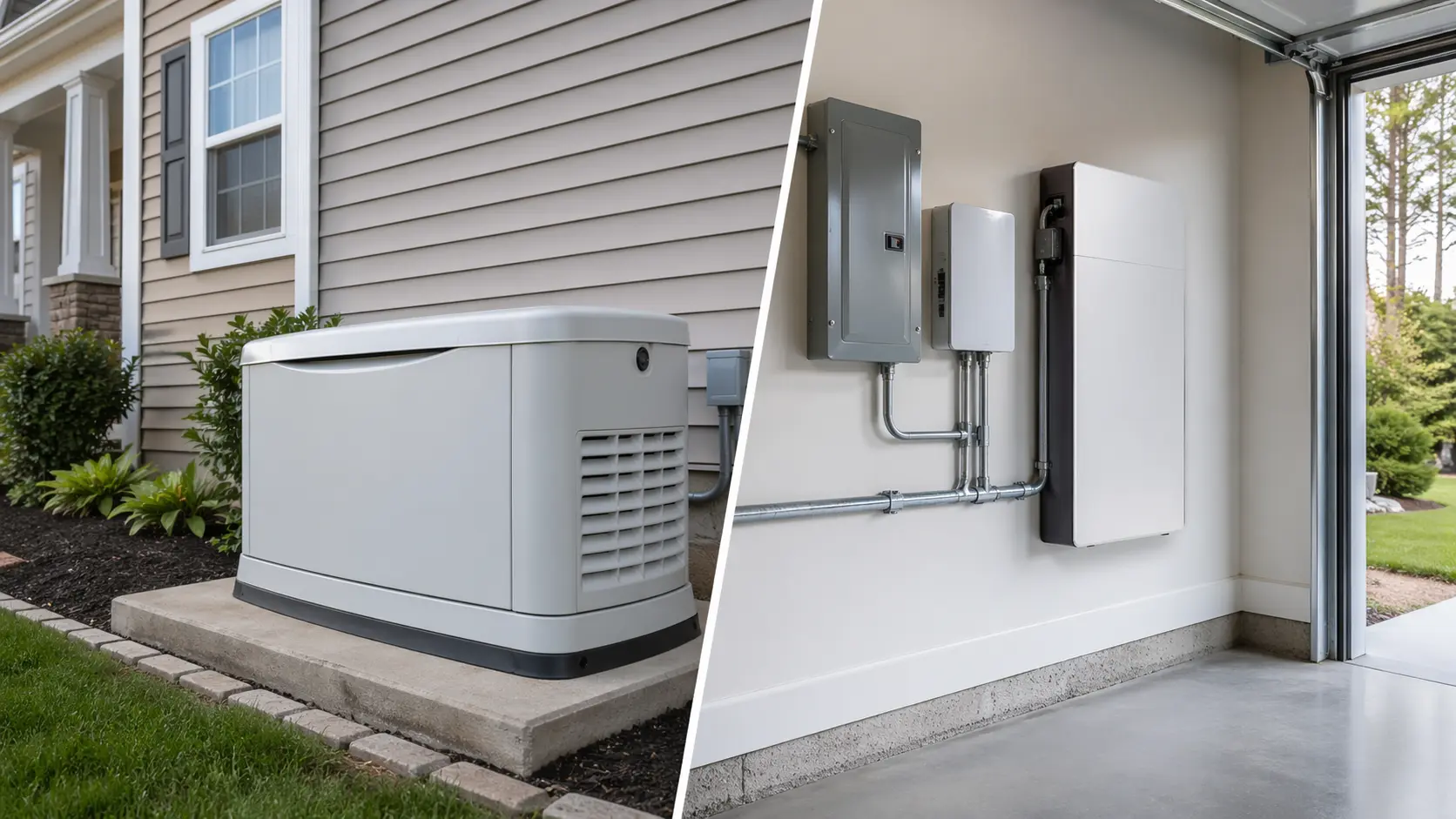
When the power goes out in New Jersey, most homeowners care about a few basic things fast: keeping the refrigerator cold, keeping the sump pump running, and keeping a few important parts of the house alive until utility power comes back.
For most homes, there are two main backup-power paths:
- a home battery backup system, often paired with solar
- a standby generator
Both can work well. They just solve the problem in different ways.
How they work
A standby generator is a permanently installed backup engine that usually runs on natural gas or propane. When utility power fails, an automatic transfer switch tells the generator to start. Power usually comes back after a short delay rather than instantly.
A battery backup system stores electricity for later use. When the grid goes down, it can switch the home, or a selected group of circuits, over to stored battery power much faster than a generator. If the home also has solar, daylight production can help recharge the battery during an outage.
For a homeowner, the simple difference is this:
- a generator makes electricity by burning fuel
- a battery stores electricity and releases it when needed
Upfront cost in New Jersey
In many homes, a standby generator is cheaper upfront than a large whole-home battery setup.
Typical installed costs often look something like this:
- air-cooled standby generator for a typical home: often around the high four figures to low five figures, with extra cost if gas-line work, propane setup, or site work is needed
- single home battery setup: often lands in the low-to-mid five figures
- larger multi-battery backup system: often climbs well beyond that
That means a generator often wins on upfront cost when the goal is broader backup power at the lowest entry price.
Fuel and runtime
This is where generators usually have the advantage.
If a standby generator is connected to natural gas, it can usually keep running as long as gas service remains available. If it runs on propane, runtime depends on tank size and how heavily the house is loaded. Current standby-generator specs in the common homeowner range are built around natural-gas or LP operation.
A battery’s runtime depends on three things:
- how much storage you installed
- how many things you are trying to run
- whether solar can recharge it during daylight
That means a battery can be excellent for shorter outages and essential loads, but it is not the same thing as unlimited backup. In a long outage with heavy loads, runtime becomes the key limitation unless the system is sized aggressively.
Better insulated from fuel shortages and supply disruptions
A standby generator depends on fuel. That may be natural gas or propane, depending on the system. In normal conditions, that can work very well. But during a longer fuel disruption, shortage, or broader emergency, your backup power still depends on that fuel source staying available.
A battery backup system works differently. It stores electricity instead of burning fuel, and when it is paired with solar, it can recharge from the panels during daylight. That makes it more self-contained than a generator and less exposed to fuel supply problems.
That does not mean unlimited power. A battery still has real limits. Runtime depends on battery size, weather, season, and how much electricity the home is using. But in a longer disruption, a solar-plus-battery system can be the more resilient choice for homeowners who want backup power that is less tied to fuel availability.
Maintenance
A standby generator has an engine, fuel system, and moving parts. That means routine maintenance matters. Oil, filters, starting batteries, and periodic service are part of ownership. Most standby generators also run regular self-test or exercise cycles, which is one reason generator ownership is more hands-on over time.
A battery system has no combustion engine and generally requires less routine maintenance. In practice, it is the simpler ownership experience day to day. Battery systems still need proper installation, software support, and occasional inspection, but they do not have the same maintenance profile as a fuel-burning generator.
Noise
A standby generator is not silent. Current 20–24 kW residential standby specs list noise around 67 dB(A) at 23 feet under normal load. That is much quieter than many portable generators, but it is still noticeable, especially in a long outage.
A battery system is effectively silent in normal operation.
For some homeowners, especially in tighter suburban neighborhoods, that alone matters a lot.
Speed during an outage
A battery system usually switches over much faster than a generator. In many homes, that means lights may flicker briefly, but the transition can feel nearly seamless.
A standby generator usually has a short delay while it detects the outage, starts, and transfers the load. That is normal behavior, not a flaw. The tradeoff is slower switchover in exchange for much longer runtime potential.
Sensitive electronics
Because battery backup tends to switch over faster, it is often easier on internet equipment, desktop computers, and other electronics that do not like interruptions.
A generator can still support those loads just fine, but some devices may reboot during the transfer delay unless they are protected by a UPS.
Equipment examples homeowners may see
Many homeowners looking for broader home backup end up comparing standby units in the 20–24 kW range.
For batteries, common examples include:
- Tesla Powerwall 3: 13.5 kWh storage, up to 11.5 kW continuous output in supported configurations
- FranklinWH aPower 2: 15 kWh storage, 10 kW continuous output, 15-year warranty
The important point for most homeowners is not memorizing specs. It is understanding whether the system is sized for essential loads only or for something much closer to whole-home coverage.
Which one makes more sense?
A standby generator usually makes more sense when:
- you want the lowest-cost path to broader backup coverage
- your outages can last a long time
- your home has heavier loads
- you already have natural gas and want long runtime
A battery backup system often makes more sense when:
- you already have solar or plan to install it
- you want backup power that works naturally with a solar system
- you want quiet operation
- you want lower day-to-day maintenance
- your main goal is protecting essential loads and shorter outages
- you value having no on-site exhaust emissions
For many homeowners already looking at solar, a battery backup system is usually the more natural fit. It keeps the system integrated, quieter, and easier to live with day to day.
Can you have both?
Yes. Some larger homes use both.
But for most homeowners, that is more system than they really need. In most cases, the real decision is whether you want the long-runtime, fuel-based approach of a generator or the quieter, solar-friendly approach of a battery backup system.
If solar is already part of the plan, battery backup is usually the cleaner fit.
The practical takeaway
If your main goal is the longest possible runtime, a standby generator still has a real advantage.
But if you are already looking at solar, want quieter backup, and want a lower-maintenance system that fits more naturally into a modern home energy setup, a battery backup system is often the better match.
That is the cleanest way to look at it: generators are strong on long runtime, while battery backup is usually the better fit for homeowners who want solar and backup to work together.
Thinking About Solar Backup for Your Home?
If you are already considering solar, battery backup is often the option worth looking at first. It can protect key parts of the home during outages, works naturally with solar production, and avoids the noise and fuel requirements of a standby generator.
Solar Me can help you evaluate whether a battery backup setup makes sense for your home, your electrical loads, and your outage concerns, so you can see clearly what level of backup is worth paying for.
