

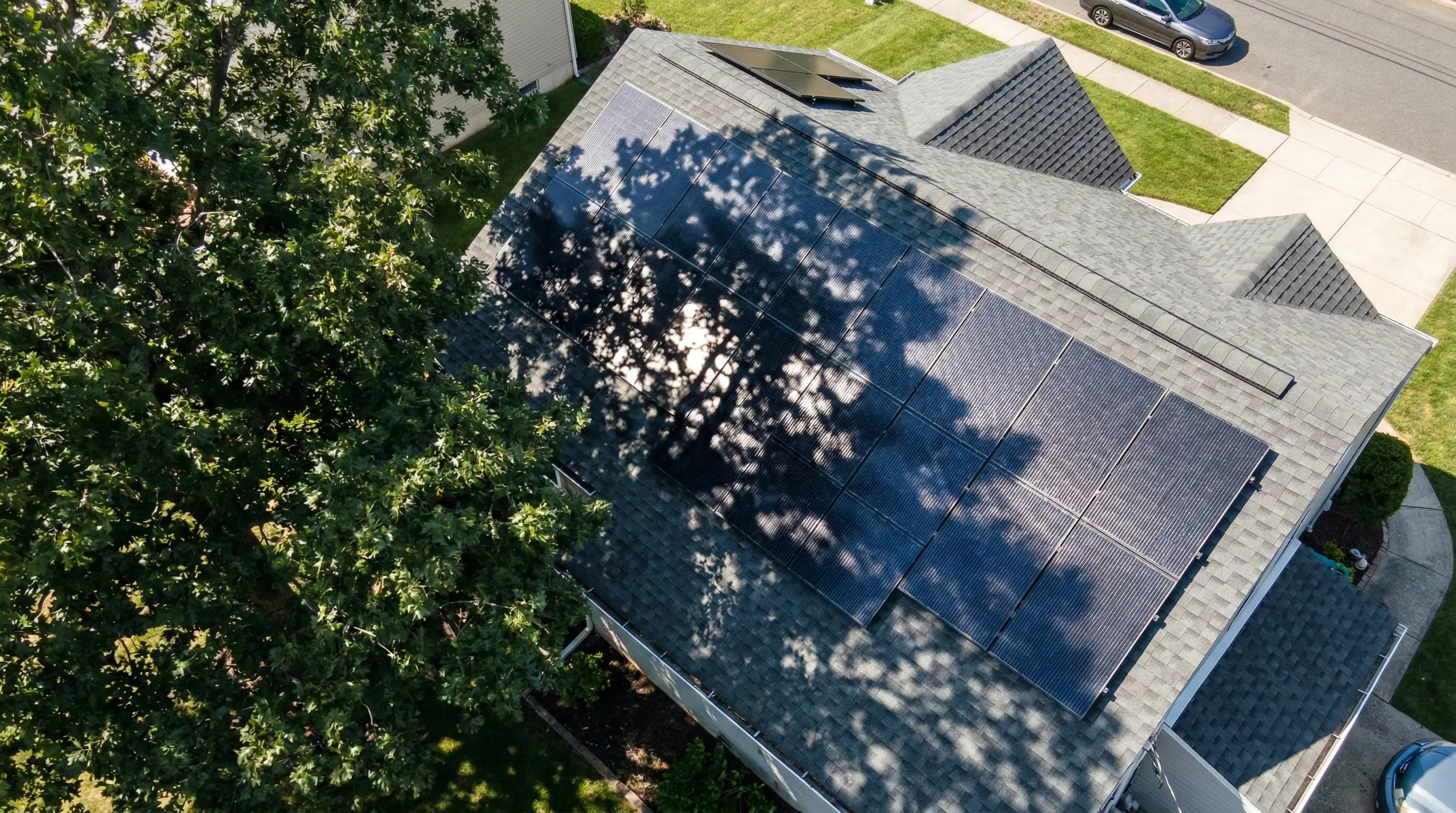
Shade doesn’t automatically rule out solar. The real question is how much shade you get, and when.
A shaded roof does not automatically take solar off the table. In fact, a lot of homes we install on have at least some shading. The key is understanding how much shade you have, where it falls, and what technology is best suited to your specific situation. That is what we figure out before we ever recommend a system.
Why Shade Matters (and How Much It Actually Affects Output)
Solar panels produce electricity by converting sunlight into power. When shade falls on a panel, that panel produces less. That is the simple part.
The more important question is: how does one shaded panel affect the rest of your system?
With traditional string inverter setups, panels in a group are typically wired in series. When one panel is shaded, it tends to limit what that string can produce. Some modern string inverters include multiple MPPT inputs, and careful stringing design can reduce shade impacts, but heavy or persistent shade still hurts output significantly.
That used to be the main limiting factor on shaded roofs. Now there are better tools for handling it.
Two Common Approaches for Shaded Roofs: Microinverters and Power Optimizers
Today there are two common types of panel-level electronics that reduce the impact of shading. Both fall under the category of Module-Level Power Electronics, or MLPE.
Microinverters attach directly to the back of each individual panel and convert power independently at the panel level. Because each panel operates on its own, shade losses are typically confined to the affected module rather than spreading across the array. Microinverters also provide panel-by-panel performance monitoring, so we can see exactly how each panel is performing at any given time.
Power optimizers take a slightly different approach. A small device attaches to each panel and conditions the DC electricity before sending it to a central inverter. They reduce mismatch and shade losses at the module level, minimizing the impact a shaded panel has on the rest of the string. Exact requirements and performance details vary by manufacturer and system design. They are often a cost-effective alternative, and the right choice between the two comes down to your roof layout, budget, and what the production numbers look like.
Both technologies are strong options for shaded roofs and represent a major upgrade over basic string inverter systems. When we assess your home, part of what we do is recommend the right technology for your specific shading situation and budget.
How We Assess Your Shade
Not all shade is created equal. There is a big difference between a chimney that casts a shadow on two panels for an hour in the morning versus a large tree that shades half your roof all afternoon.
When we come out to your home, we model annual shade loss by month and hour to understand how the sun moves across your roof throughout the day and across every season. This gives us a precise picture of how much production you can realistically expect, not just a guess.
On a site visit, we are basically trying to answer four questions:
- What is causing the shade — trees, chimneys, dormers, neighboring buildings, vents
- When the shade falls — for south-facing panels, morning shadows matter less than midday shade in terms of total annual kWh; for east-facing panels, the opposite is often true since morning is their peak production window
- How much of the roof is affected — a small shadow on the edge of one panel is very different from full coverage across a large section
- Whether the obstruction can be addressed — where feasible, trimming a tree or repositioning panels on a different part of the roof can make a meaningful difference; practical constraints like permits, HOA rules, or neighbor property lines are part of that conversation
Once we map that out, we can size and design a system with fewer surprises.
When Shade Is a Bigger Problem
There are situations where shade is significant enough that going solar may not make financial sense, at least not on that particular roof surface.
If the primary roof faces are heavily shaded for most of the day throughout the year, output may be too low to justify the investment. In these cases, we explore every option first: different panel placement, using less-shaded sections of the roof, or in some situations, a ground-mounted system if your property allows for it.
Our goal is to give you a clear answer upfront, not sell you a system that underdelivers.
South, East, West — And Even Some North
In the northern hemisphere, south-facing roof surfaces produce the most solar energy throughout the year. Southeast and southwest-facing surfaces are also strong performers.
East and west-facing roofs are very workable. An east-west split, with panels on both sides of a pitched roof, is a common and effective setup that captures morning and afternoon sun across different parts of the array.
North-facing roof planes typically produce significantly less in this region, and we only recommend them in specific cases, usually when roof pitch is low, other surfaces are constrained, and the numbers still work based on projected annual production. We look at every surface and tell you what it can actually do.
The Bottom Line
If you have been holding off on solar because of shade, it is worth having a real conversation before writing it off. The technology available today is dramatically better than it was even five years ago, and a professional site assessment gives you real data rather than guesswork.
We assess every home individually. We look at your roof, your shade patterns, your energy usage, and your goals, and we tell you what is possible and what makes financial sense.
If solar works for your home, we will show you exactly how. If it does not, we will tell you that too.
Curious whether your roof qualifies? Reach out to us for a free assessment and we will give you a clear, honest answer.
👉 Schedule Your Free Solar Review
📞 Or call (844) 734-6610.
Disclaimer: Solar system performance varies based on site-specific conditions including shading, roof orientation, panel technology, and local climate. Contact us for a personalized evaluation of your home.
