

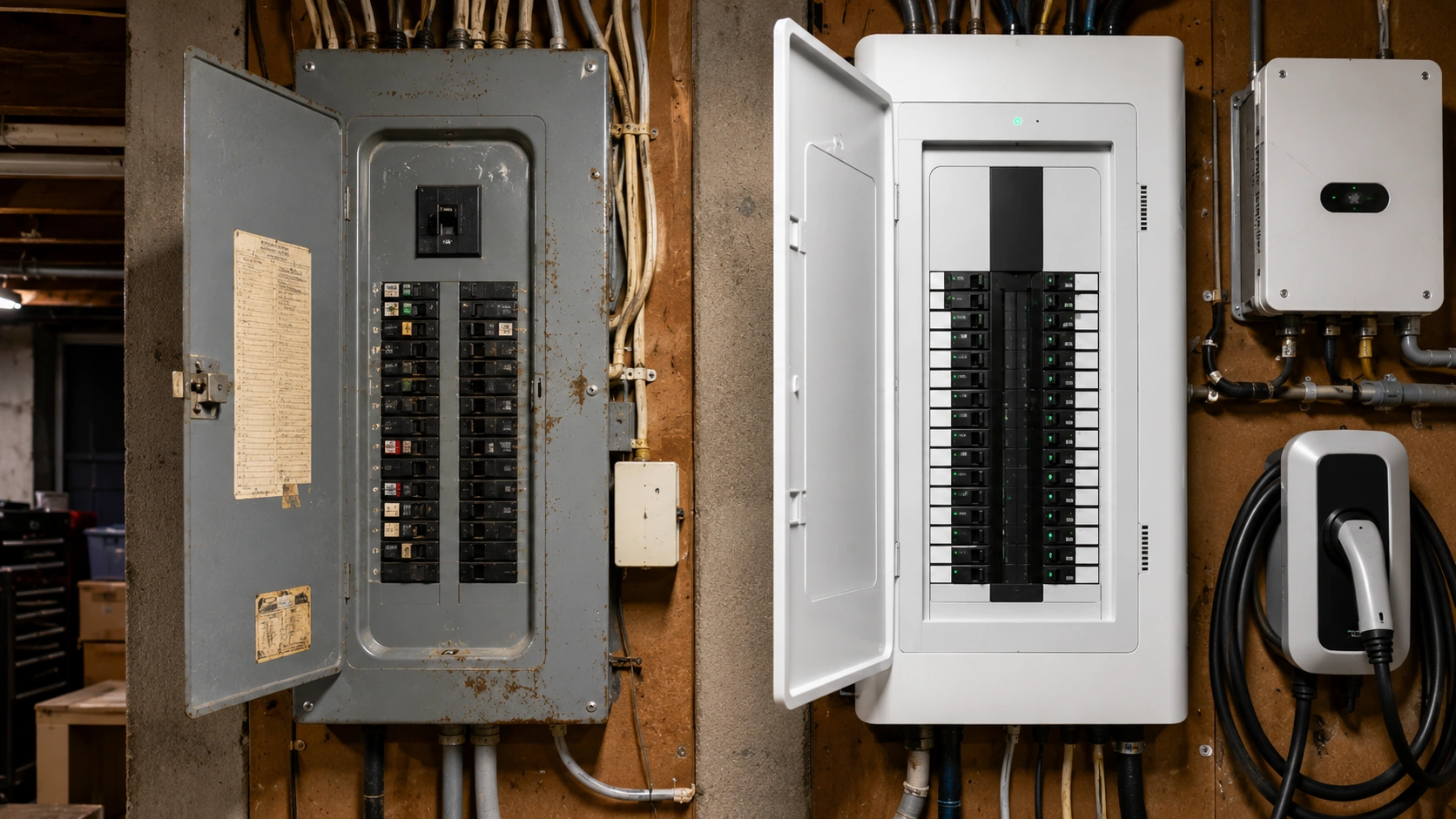
You've done the homework. You know how many panels your roof can hold, you've read about incentives, and you're ready to sign. Then the site assessment turns up a sentence you weren't expecting: "Your electrical panel can't take it."
This happens more than you'd think in New Jersey, where a lot of housing stock predates central air, let alone EV chargers. The good news is that "your panel can't take it" has several answers, and a full utility service upgrade is only one of them. Here's how to understand what's going on inside that gray box and what your options actually cost.
The rule that decides everything: 120%
Inside your main electrical panel is a busbar, the metal strip that every breaker draws power from, and it's rated for a certain number of amps, usually 100 or 200 in a home. The National Electrical Code (section 705.12, if you want to look it up) says that the main breaker plus the solar breaker feeding power back into the panel can't exceed 120% of the busbar rating.
Run the math for the two most common panels:
- 200-amp panel: 200 x 1.2 = 240. Subtract the 200-amp main breaker, and there's room for a 40-amp solar breaker, which supports roughly 7.6 kW of inverter output. That covers most New Jersey homes comfortably.
- 100-amp panel: 100 x 1.2 = 120. Subtract the 100-amp main, and you're left with a 20-amp solar breaker, about 3.8 kW. That's a small system, often smaller than the house needs.
So the panel question is really a math question. If the system you need fits inside that margin, you may not need to touch the panel at all. If it doesn't, keep reading. (Not sure what size system you need? Start with how many solar panels your home needs.)
Signs your panel needs replacing regardless of solar
Some panels should be replaced whether or not you ever go solar. Red flags:
- A fuse box instead of breakers
- A Federal Pacific, Zinsco, or Challenger panel, brands with a documented history of breakers that fail to trip
- 60-amp service, still found in older NJ homes
- Breakers that trip under normal use, lights that dim when the AC kicks on, or a buzzing or burning smell at the panel
- No open slots for new breakers
If any of these describe your house, the panel is a safety and capacity problem first and a solar problem second. Fix it before adding anything.
Option 1: The utility service upgrade (100 to 200 amps)
The traditional answer. An electrician replaces the panel and the meter box, and often the heavy wires that bring power in from the street, and your utility (PSE&G, JCP&L, or another New Jersey provider) swaps the meter and reconnects at the new capacity.
Cost in New Jersey in 2026: national cost guides put a basic 100-to-200-amp upgrade at roughly $1,300 to $3,000, but New Jersey contractors quote $3,500 to $4,800 for the full job once you include the permit, the utility coordination, and the meter and service work most of our older homes require. Municipal permits add $150 to $500 and one to four weeks of processing.
Timeline: the work itself is a day, but scheduling the utility can stretch the process to several weeks. When the upgrade is part of a solar project, it gets built into the schedule rather than tacked on.
When it's the right call: old, unsafe, or undersized panels; homes planning to electrify heavily (heat pumps, induction, two EVs); or homes where the panel is simply full.
Option 2: Code-approved workarounds
Electricians have a few tools for squeezing a solar breaker into a panel that's technically over the 120% line:
- Main breaker derate. Swap the 200-amp main for a 175-amp main to free up extra room on the busbar. Only works if a load calculation shows the house doesn't need the full 200.
- Supply-side (line-side) tap. Connect the solar ahead of the main breaker, before the point where the 120% rule is measured. Requires utility approval and a clean spot to make the connection.
- Subpanel. Land the solar on a downstream panel with spare capacity.
These are legitimate and common, but they're fixes for the solar breaker only. They don't add capacity for an EV charger or a heat pump later.
Option 3: A SPAN smart panel that manages the load instead
This is the option most homeowners haven't heard of, and it's the one that changes the math. A SPAN panel replaces your breaker panel with one that monitors and controls every circuit individually from an app. Because it knows exactly how much power the house is drawing at any moment, it can automatically pause or throttle flexible loads, like an EV charger, when the total approaches the service limit.
The code recognizes this. NEC 705.13 allows a certified "power control system" to automatically keep the total power draw under the panel's limit, and SPAN's panels are certified to the UL 3141 safety standard written for exactly that. In practice, this means a home with 100-amp service can often add solar, a battery, and an EV charger without a utility service upgrade, because the panel is designed to keep the total under what the service can deliver.
Solar Me installs SPAN smart electrical panels, and the service page lists what you get: circuit-level monitoring and control, remote on/off for any circuit from the SPAN app, optimization for solar and battery, and a SPAN Drive EV charger that charges when rates are lowest. We covered the day-to-day experience in Smart Electrical Panels 101.
Cost: SPAN panel hardware runs roughly $2,500 to $4,100 depending on the model, plus installation. That's more than a plain 200-amp panel, so a SPAN panel isn't the cheapest way to solve the solar-breaker problem by itself. It earns its price when you're planning more than one thing: solar now, an EV charger next year, a backup battery after that. Each of those would normally trigger another look at the panel. With SPAN, the panel is the plan.
Whether SPAN avoids a service upgrade on your specific house is a design and permitting question, decided by the load calculation and your local inspector, not something a brochure can promise. That's exactly what the site assessment settles.
A quick decision guide
- 200-amp panel, healthy, with open slots: you're probably fine. Solar goes in with a standard solar breaker.
- 200-amp panel, but you also want an EV charger, battery, or heat pump: consider SPAN. It keeps future projects from turning into panel projects.
- 100-amp panel, small system, no other plans: a smaller main breaker or a line-side tap may be all you need.
- 100-amp panel plus solar plus EV: SPAN or a service upgrade. SPAN if you want circuit control and outage management; the upgrade if the panel is old or unsafe anyway.
- Fuse box, Federal Pacific, 60-amp, or a burning smell: replace it. Full stop.
Frequently asked questions
Do I need to upgrade my electrical panel for solar?Not always. Under the NEC 120% rule, a healthy 200-amp panel can usually take a 40-amp solar breaker (about 7.6 kW) without changes. A 100-amp panel is limited to about 3.8 kW, so larger systems need a derate, a line-side tap, a smart panel, or a service upgrade.
How much does a 200 amp panel upgrade cost in NJ?Full 100-to-200-amp service upgrades in New Jersey typically run $3,500 to $4,800 including permits and utility coordination, higher than national averages because of meter and service entrance work common in older homes.
Can a smart panel avoid a service upgrade?Often, yes. A SPAN panel is a certified power control system that limits total draw by pausing flexible loads like EV charging, which can let a 100-amp home add solar, a battery, and a charger. Whether it works for your house depends on the load calculation and your local inspector.
What is the 120% rule for solar?NEC 705.12: the main breaker plus the solar breaker can't exceed 120% of the panel's busbar rating. For a 200-amp panel, that's 240 amps total, leaving room for a 40-amp solar breaker.
How much does a SPAN panel cost?Hardware is roughly $2,500 to $4,100 by model, plus installation. It costs more than a standard panel but replaces the need to revisit the panel each time you add solar, storage, or EV charging.
Find out what your panel can handle
The answer is in your basement, and it takes one visit to read it. Request a free assessment and we'll size the system, check the panel, and tell you which of these options actually fits your house.
