

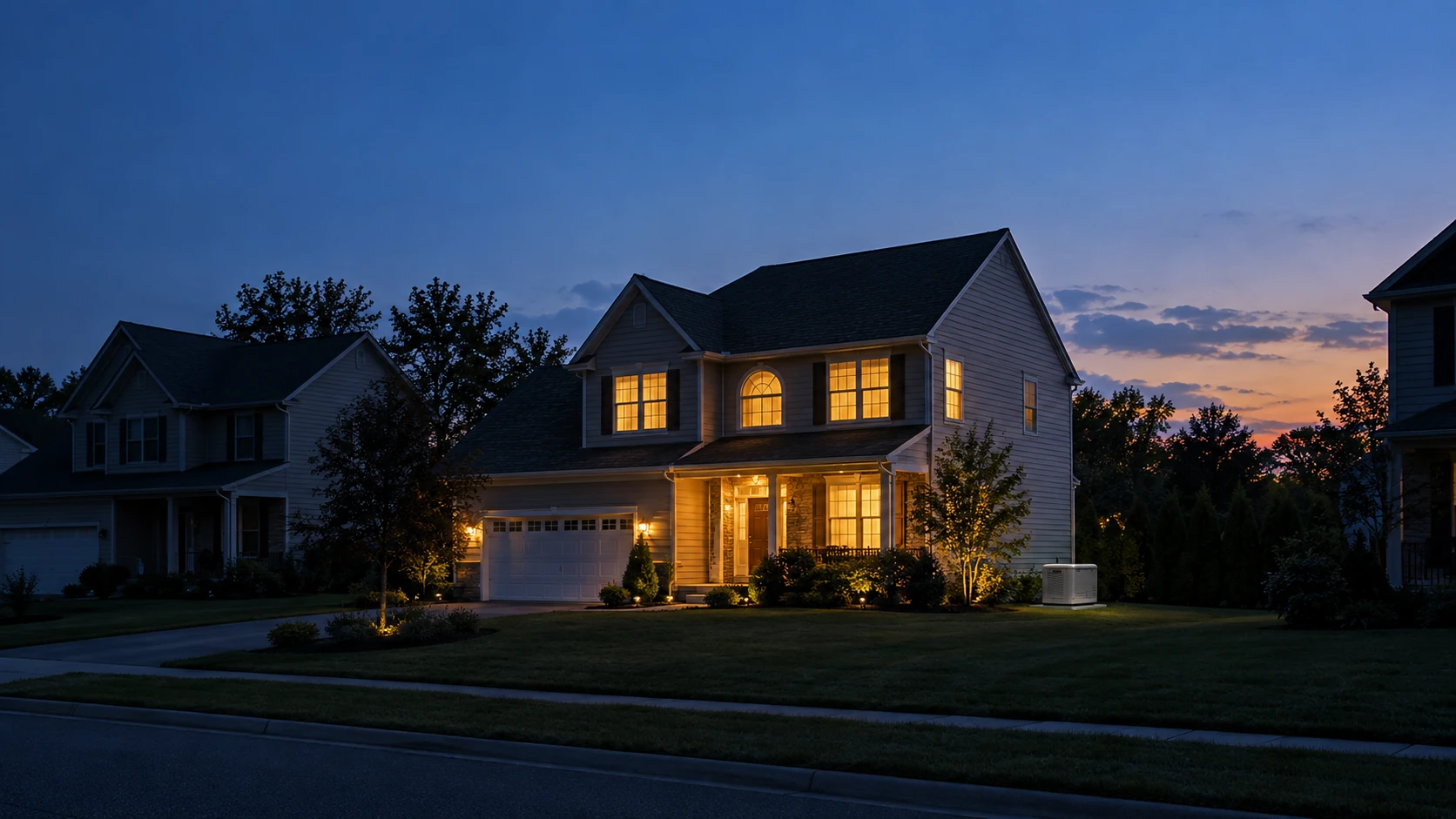
Picking a generator size feels like it should be simple: bigger house, bigger generator. In reality, the right size depends much more on what you want running during an outage than on your square footage. A 2,500-square-foot home with gas heat and one air conditioner can need less generator than a smaller home with electric heat, an electric range, and an EV in the garage.
Here's how Generac's popular 14kW, 22kW, and 26kW home standby generators compare, and how to figure out which one fits your house.
First, what "kW" means
A kilowatt (kW) is a measure of how much power a generator can supply at the same time. A 22kW generator can deliver up to 22,000 watts at once. Add up the watts of everything running together, and you want that total to stay comfortably under the generator's limit.
Generac makes air-cooled home generators in several sizes, including 10, 14, 18, 22, 24, 26, and 28kW. The 14, 22, and 26kW models are three of the most common choices for New Jersey homes.
Natural gas lowers the rating
Here's a detail that surprises a lot of people. Generac's sizes are named for their output on propane. Natural gas carries less energy, so most models put out a little less power when running on it.
Using Generac's current spec sheets for its newest models:
ModelOn propaneOn natural gas14kW14,000 watts14,000 watts22kW22,000 watts21,000 watts26kW26,000 watts24,000 watts
Older Generac Guardian models are rated a bit lower on natural gas (for example, 19,500 watts for a 22kW and 22,500 watts for a 26kW). If your home has natural gas, a direct connection to your gas line means you never have to refuel during a long outage. Just remember to size using the natural gas number.
Running watts vs. starting watts
Anything with a motor, like an air conditioner, well pump, or sump pump, needs a quick burst of extra power to start. Generac notes that starting power is often two to three times the running power.
Some typical running figures to give you a feel for it:
- Refrigerator: about 150 to 400 watts
- Furnace fan: about 300 to 800 watts
- Sump pump (1/2 horsepower): about 800 to 1,050 watts
- Central air (3-ton): about 3,500 to 5,000 watts, per Generac, with a much bigger surge at startup
- Electric water heater: about 3,000 to 4,500 watts
- Electric dryer: about 4,000 to 6,000 watts
- Level 2 EV charger: about 7,000 watts or more
Those big ones at the bottom are what push a home into a larger generator. Always check the label on your own equipment, because models vary.
What each size can typically handle
These are general guidelines. Your house needs a real load calculation, but this gets you in the right neighborhood.
14kW: the essentials, and then some. Generac points to 10 to 14kW for covering essential circuits in homes around 1,500 square feet. A 14kW can typically run a refrigerator, lights, outlets, internet, a furnace, a sump pump, and possibly one smaller central air unit. It's a good fit for smaller homes or anyone who only needs the important things running.
22kW: the whole-house sweet spot. Generac describes 22kW as the standard for whole-home coverage in houses of about 2,500 to 3,000 square feet. For a lot of New Jersey homes with gas heat, a 22kW can run nearly everything, including one central air system, without you having to think about it.
26kW: bigger homes and bigger loads. When you add a second air conditioner, electric cooking, an electric water heater, or EV charging, you start needing more room. The 26kW, or the even larger 28kW, gives that extra room for larger homes or all-electric setups.
Load management: getting more from a smaller generator
You don't always need to size for every appliance running at once. Generac's Load Managers (formerly called Smart Management Modules) watch the generator and temporarily switch off big items, like a second air conditioner or a water heater, when the generator gets close to its limit. When power frees up, they turn back on.
Generac says these can reduce the generator size a home needs. In plain terms, a well-planned 22kW with load management can often do the job of a bigger unit, for less money.
Our sizing rule of thumb
Figure out your realistic "everything on at once" number, then add about 10% extra as a cushion. That headroom keeps the generator from running at its limit, handles motor startups more comfortably, and leaves room for things you might add later.
What each size costs
Generac's own list prices for its newest models, with a 200-amp automatic transfer switch included (the device that switches your home to generator power when the grid goes down), are:
- 14kW: about $5,949
- 22kW: about $7,369
- 26kW: about $8,219
That's equipment only. Installation adds the concrete pad, gas piping, electrical work, permits, and inspections. New Jersey contractors commonly report installed totals in roughly the $11,000 to $18,000 range for these sizes, depending on the distance to your gas meter and electrical panel, whether your gas meter needs an upgrade, and site conditions. We cover the full process in our guide to whole-house backup generators in NJ.
A few NJ-specific things to plan for
Your gas utility has to sign off. A generator uses a lot of gas at full power, so the gas meter and line have to be big enough. PSE&G requires customers to apply before adding a gas generator, and New Jersey Natural Gas asks you to contact them before buying one. If the meter needs upgrading, it can add a few weeks.
Placement matters. Generac's installation guidelines keep the unit at least 5 feet from windows, doors, and vents, and 18 inches from the house. Local codes can add more.
Noise. Generac rates these models at about 65 to 67 decibels measured from 23 feet away. The generator also runs a short self-test on a schedule (weekly by default) to make sure it's ready, and the newest models can do that test in a quieter, low-speed mode.
Monitoring. Generac's Mobile Link lets you check your generator's status from your phone. The newest models come with a cellular connection built in. A free plan shows status and history, while instant text and email alerts are part of Generac's paid premium plan.
Warranty and upkeep. These models carry Generac's 5-year limited warranty. Like any engine, they need regular maintenance. We offer preventive maintenance and repairs using authorized factory parts.
Frequently asked questions
What size Generac generator do I need for a 2,500 square foot house?Many homes that size with gas heat and one central air system fit a 22kW. Electric heat, a second air conditioner, or EV charging can push you to 24kW or larger, or to a 22kW with load management.
How much does a Generac 22kW generator cost?Generac lists its newest 22kW with a 200-amp transfer switch at about $7,369 for the equipment. Installed prices in New Jersey commonly land in the low-to-high teens, depending on the site.
Is a 26kW Generac the biggest?No. Generac also makes a 28kW air-cooled model, and larger liquid-cooled generators exist for very large homes and businesses.
Why is my generator rated lower on natural gas?Natural gas carries less energy than propane, so the same engine makes less power on it. A 22kW is rated at 21,000 watts on natural gas on Generac's newest models.
Can a smaller generator run my whole house?Sometimes. Load management can switch big appliances off and on so a smaller generator covers the whole home, as long as those items don't all need to run at the same time.
Get the size right the first time
The most expensive generator is the one that's the wrong size. We install Generac standby generators across New Jersey with direct natural gas connections and Mobile Link monitoring. Request a free consultation and we'll size a generator around what your home actually needs to keep running.
