

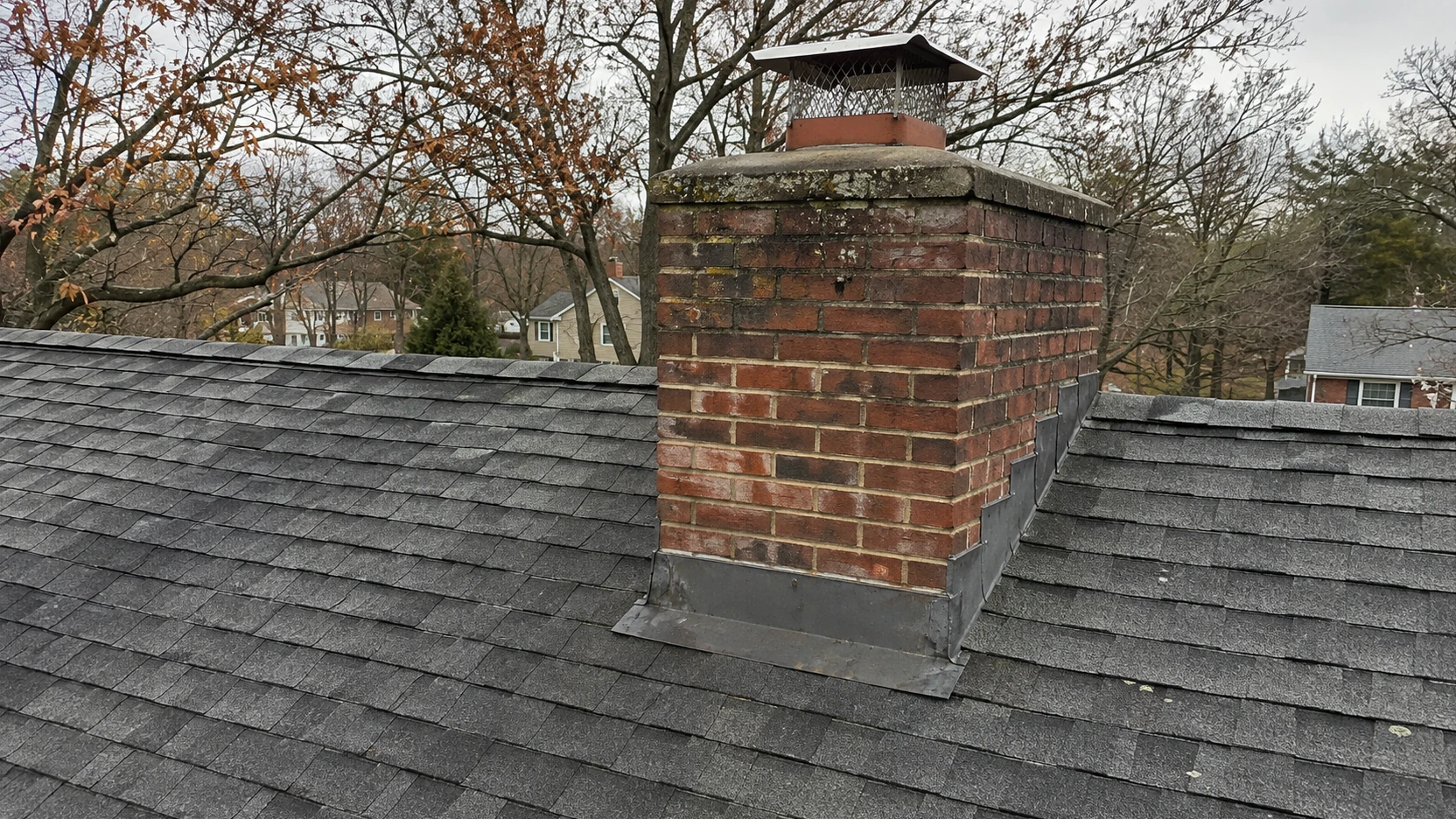
When a ceiling stain shows up, most people blame the shingles. Often the shingles are fine. The weak spots on a roof are the seams: where it meets a chimney, a wall, a vent pipe, or a skylight, or where two slopes come together.
Every one of those seams is protected by flashing. When it fails, water gets in, even on a roof with years of life left.
What flashing is (and where it lives)
Flashing is thin metal or rubber shaped to steer water away from a joint and back onto the shingles. The main types:
- Step flashing: L-shaped pieces woven into the shingles where a roof runs alongside a wall or chimney.
- Counterflashing: a second layer covering the step flashing, set into the brick's mortar joints on a chimney.
- Chimney crickets: a small peaked "saddle" on the uphill side of a chimney so water splits around it. The residential building code calls for one when a chimney is more than 30 inches wide and doesn't sit at the roof peak.
- Valley flashing: lining where two slopes meet.
- Pipe boots: rubber collars around plumbing vents.
- Drip edge: metal along the roof edges that carries water off and away from the wood trim.
- Kickout flashing: a small angled piece where a roof edge ends against a wall, so water goes into the gutter instead of down the siding.
Kickout flashing is one of the most commonly skipped pieces, even though the building code has required it on new work since 2009. Without it, runoff can soak into the wall and rot the sheathing (the plywood under the siding) long before anyone sees a drip inside.
Why flashing fails
- Rubber pipe boots crack from sun and temperature swings, letting water run down the vent pipe into the attic.
- Chimney mortar wears out, and the counterflashing anchored in it pulls loose.
- Caulk was doing a flashing job. Sealant is a backup, not a waterproofing system, and it dries out and cracks over time.
- New Jersey winters. Freeze-thaw cycles work joints loose, and ice dams (ridges of ice at the roof edge) push water under shingles and over flashing.
- It was reused, or never installed in the first place.
Signs your flashing is the problem
Look for leaks that line up with a joint:
- Ceiling stains near a chimney, skylight, exterior wall, or bathroom
- Dark spots on attic boards around a vent pipe or the chimney
- Peeling paint, soft trim, or stained siding where a roof edge meets a wall
- Gaps, rust, or bent metal around the chimney
- Thick globs of caulk or tar, a sign of past patching
- Leaks that show up only in wind-driven rain or when snow melts
What roof flashing repair costs
National cost guides put typical recent ranges at:
- General flashing repair: $200 to $600
- Pipe (vent) boot replacement: $100 to $600
- Valley leak repair: $300 to $1,500
- Chimney flashing repair or replacement: $400 to $1,600
Steep roofs, large chimneys, copper flashing, or rotted decking (the plywood under the shingles) push the price up. These are industry ranges, not our pricing.
Repair the flashing, or replace the roof?
If the shingles have plenty of life left, a flashing repair is usually the right call: targeted, relatively inexpensive, and often finished in a single visit. If the roof is near the end of its life, it makes more sense to handle the flashing as part of a full replacement, with new step flashing, pipe boots, and drip edge rather than old pieces reused. Our NJ roof replacement cost guide covers the signs that a full roof is due.
Planning solar? Get flashing problems fixed first. It's part of checking whether a roof is ready for solar.
Will insurance pay?
Homeowners insurance generally covers sudden damage, like wind tearing flashing loose. It generally doesn't cover flashing that wore out with age. Some policies treat water damage inside the home differently, so ask your insurer and photograph any storm damage.
Frequently asked questions
What is roof flashing?
Metal or rubber material installed at roof joints, such as chimneys, walls, vents, skylights, and valleys, to steer water away from the seam and back onto the shingles.
How much does roof flashing repair cost?
National cost guides put general flashing repair at about $200 to $600 and chimney flashing at about $400 to $1,600. Steep roofs and hidden rot can raise the price.
How do I know if my roof leak is from the flashing?
Stains near a chimney, skylight, vent, or wall often point to flashing. Water can travel along the framing before it drips, so a stain isn't always directly below the source.
Can flashing be fixed in winter?
Usually, yes. Some sealants don't bond well in deep cold, so certain details may be finished when it warms up, but a leak shouldn't wait.
Stop the leak at its source
A small flashing leak soaks decking and insulation all winter and turns into a much bigger repair. SolarMe's free roofing inspection checks your flashing and ventilation along with the shingles, so you'll know what needs fixing and what it will cost.
Book your free SolarMe roofing inspection and have your flashing checked before the next storm.
