

If you have a solar system and spent the last few months watching your production numbers sit lower than you expected, you are not alone — and in most cases, nothing is wrong with your panels.
What you experienced this winter is completely normal. It happens every year, it is fully accounted for in how we size systems, and it is about to reverse in a big way. Here is exactly what happened, and what you can look forward to over the next few months.
Three Things That Hit Your Output This Winter
Winter production drops are not caused by one single thing. They are the result of three factors stacking on top of each other at the same time.
Shorter days. This is the biggest one. In December and January, the sun rises later and sets earlier than at any other point in the year. That means your panels have fewer hours of daylight to work with, period. Fewer hours in, fewer kilowatt-hours out.
Lower sun angle. Even during the hours when the sun is up, it sits lower in the sky during winter than it does in summer. A lower sun angle means sunlight hits your panels at a less direct angle, reducing how much energy each panel can absorb per hour. Think of it like a flashlight aimed almost sideways at a wall — it illuminates a large patch dimly rather than a small spot brightly. Same energy source, less intensity per square foot.
More cloud cover and weather. Winter in New Jersey and the surrounding region often brings more overcast days, more storm systems moving through, and generally less consistent sunshine. Panels still produce on cloudy days, but output is reduced compared to clear-sky conditions.
Stack these three things together from roughly November through February, and you end up with systems in the Mid-Atlantic region generating significantly less than their spring and summer output. That is not a malfunction — it is physics.
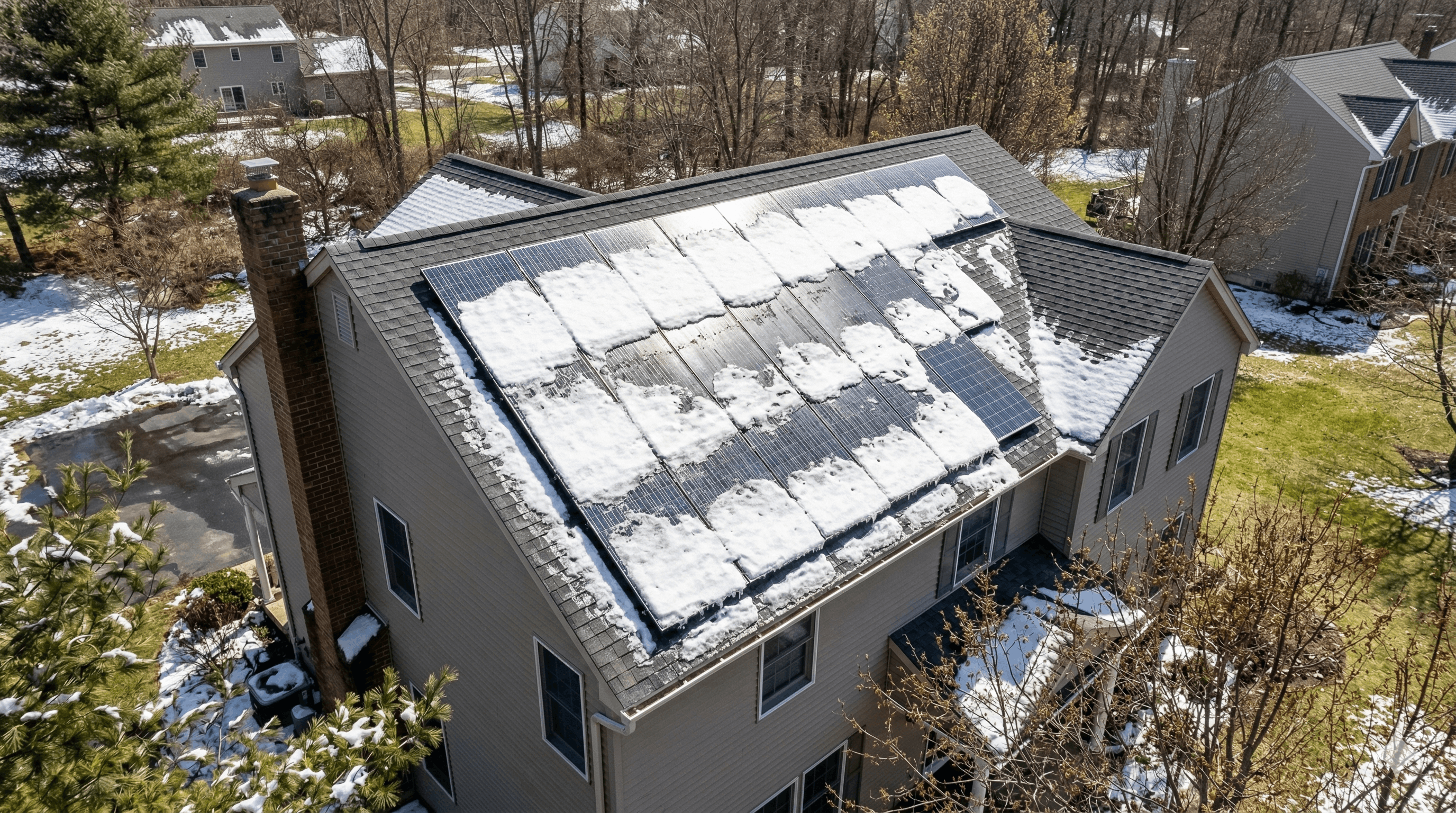
What About Snow?
Snow sitting on panels does reduce output, since it blocks sunlight from reaching the cells. However, most residential panels are mounted at an angle that allows snow to slide off reasonably well, especially when sun and temperatures cooperate. A light dusting typically clears on its own within a day or two. Heavy accumulation can take longer, and on low-slope roofs or during back-to-back storms, snow can account for a more meaningful slice of winter losses. But for most systems in this region, the shorter days and lower sun angle are doing the bulk of the work regardless.
The Counterintuitive Thing About Cold Weather
Here is something a lot of homeowners are surprised to learn: solar panels produce more power at a given sunlight level when their cells are cooler.
Solar cells are semiconductor devices, and their efficiency is sensitive to temperature. As panels heat up, voltage output drops — and since power is a product of voltage and current, lower voltage means less output. In cold conditions, that voltage stays higher, which is why panels perform better per hour when it is cool. In fact, on a cold, clear winter day, panels can run closer to their nameplate output than they do in summer heat — and sometimes briefly exceed it under the right irradiance conditions, depending on inverter sizing.
The catch is that in the heart of winter, New Jersey systems typically see around 3 peak sun hours per day — a common way to express available sun energy. By June and July, that climbs to roughly 4.5 to 5, depending on your site and conditions. More hours in means more kilowatt-hours out, which is why summer still comes out ahead overall. But it does mean that on those crisp, sunny January days, your system was likely running as efficiently as it ever does — just for a much shorter window.
Why Spring Is the Sweet Spot
Spring is where the turnaround begins — and March is where that ramp-up really starts.
As the days get longer, your panels get more hours of direct sunlight. As the sun climbs higher in the sky toward its summer position, the angle improves and each hour of sunlight delivers more energy. And because temperatures in spring are still cool rather than hot, panels are running at high efficiency while also getting more hours of work.
Many NJ systems see their highest production in late spring to early summer — often May or June — when days are long, the sun angle is strong, cloud cover tends to be lower than it is in March and April, and temperatures have not yet climbed to the point where heat starts eating into efficiency. That said, exact timing varies by site, weather patterns, and system orientation. March is the start of the ramp, not the top of it. But the direction is clearly and decisively upward from here.
For Mid-Atlantic homeowners with solar, the stretch from March through September often accounts for around 60 to 70 percent of the system's entire annual production. That ramp-up starts now.
This Is How the System Is Designed to Work
If you are looking at your production history and feeling concerned that your winter output did not cover all of your electricity use, that is expected — and it was anticipated when your system was sized.
When we design a solar system for a home, we do not size it to perfectly match usage every single month. We size it to offset your annual consumption. The spring and summer months generate a surplus, which under net metering flows back to the grid and earns you credits. Those credits carry over month to month and offset the periods when your system produces less than you use — like January and February. In New Jersey, remaining credits at the annual reconciliation are generally paid out at an avoided-cost style rate rather than full retail — so most homeowners aim to size their system to roughly match annual usage rather than significantly overproduce.
If your system is performing as projected on an annual basis, the winter dip is not a problem. It is the plan.
What to Do Right Now
With production ramping up over the next few weeks, spring is a good time to do a quick checkup on your system:
- Check your monitoring app. Production numbers should be climbing noticeably through March and April. If they are not trending upward with the season, that is worth looking into.
- Look at your panels. Winter can leave a layer of grime, pollen, or debris on the glass. A good rain usually handles this on its own. If you do rinse them manually, avoid hard tap water — it can leave mineral deposits that make soiling worse over time. Use deionized or distilled water, rinse from the ground with the right equipment, and skip pressure washers, abrasive tools, or cold water on hot glass. Hire it out if you are not set up to do it safely. Roof safety comes first.
- Review your net metering credits. Pull up your utility account and see what you banked through the fall. You should be building that credit balance back up quickly now.
If anything looks off or you have questions about your production, reach out to us. We can pull up your system's data and tell you exactly how it is performing relative to projections.
The Bottom Line
Lower winter output is not a sign that something went wrong. It is the natural rhythm of solar production in the northeast — shorter days, a lower sun, more clouds. Your system was designed with all of that in mind. And right now, with the days getting longer and the sun climbing back into position, the best months of the year for solar production are just getting started.
Have questions about your system's production or thinking about going solar before the peak season hits? Reach out to us for a free assessment.
👉 Schedule Your Free Solar Review
📞 Or call (844) 734-6610.
Disclaimer: Solar system performance varies based on site-specific conditions including system size, roof orientation, panel type, shading, and local weather patterns. Contact us for a personalized production estimate for your home.
