When people say “my solar system is old,” they usually mean one of two things: something failed, or their home changed and the system no longer fits. A failed inverter, damaged panels, a new roof, an EV, a heat pump, rising household usage, or monitoring that stopped updating can all trigger the same question: do I need to replace everything?
In many cases, you don’t.
Solar is modular. You can often swap a failed inverter, replace a handful of damaged panels, refresh monitoring, or expand capacity without ripping the whole thing off the roof. The key is knowing where partial upgrades are straightforward, and where they turn into a chain reaction because one new component forces other changes for electrical compatibility, code compliance, or utility requirements.
The Quick Answer
Yes, homeowners can often replace or upgrade part of a solar system.
Partial upgrades usually go well when:
- one component failed (inverter, a few panels, a monitoring gateway)
- you’re fixing a known issue (communications, wiring damage, broken roof flashing)
- you’re expanding in a way that fits your existing system design and electrical limits
- you’re already doing related work (roof replacement, main panel work)
Partial upgrades tend to get messy when:
- key equipment is discontinued and no longer has clean replacements
- the upgrade changes your inverter architecture (string to microinverters, or the reverse)
- the project triggers major rework (restringing, new rapid shutdown method, service changes)
- utility interconnection rules treat the modification as a larger re-review
Know the Parts Before You Upgrade Anything
Most residential systems include:
- solar modules (panels)
- inverter setup (string inverter, microinverters, or optimizers plus an inverter)
- mounting and roof flashing
- DC and AC wiring, disconnects, and rapid shutdown equipment
- monitoring gateway and internet connection
- main electrical panel (and sometimes a solar subpanel)
- utility meter and interconnection approval
A “partial upgrade” means changing one category while leaving most of the others in place.
The Most Common Partial Upgrades That Often Make Sense
1) Replacing a failed inverter
Inverters are a frequent replacement item in the life of a solar system because their typical service life is often shorter than the panels. A common rule of thumb is that many centralized string inverters last around 10–15 years, and warranties are often in the 5–10 year range (with options to extend on many models).
A replacement can be fairly clean when:
- the new inverter matches your array’s electrical requirements (voltage/current limits)
- existing conduit runs and disconnect locations can be reused
- the replacement meets current electrical code requirements for shutdown and labeling
- the utility does not require a full redesign review
What can complicate it:
- the exact model is discontinued and the closest replacement needs system changes
- the old design relied on specific string lengths that don’t map neatly to the new inverter
- monitoring hardware was tied to the old inverter platform
Practical homeowner takeaway: if your inverter failed and your panels are still producing normally for their age, a targeted inverter replacement is often the smartest move before you consider a full system replacement.
2) Replacing a few damaged panels
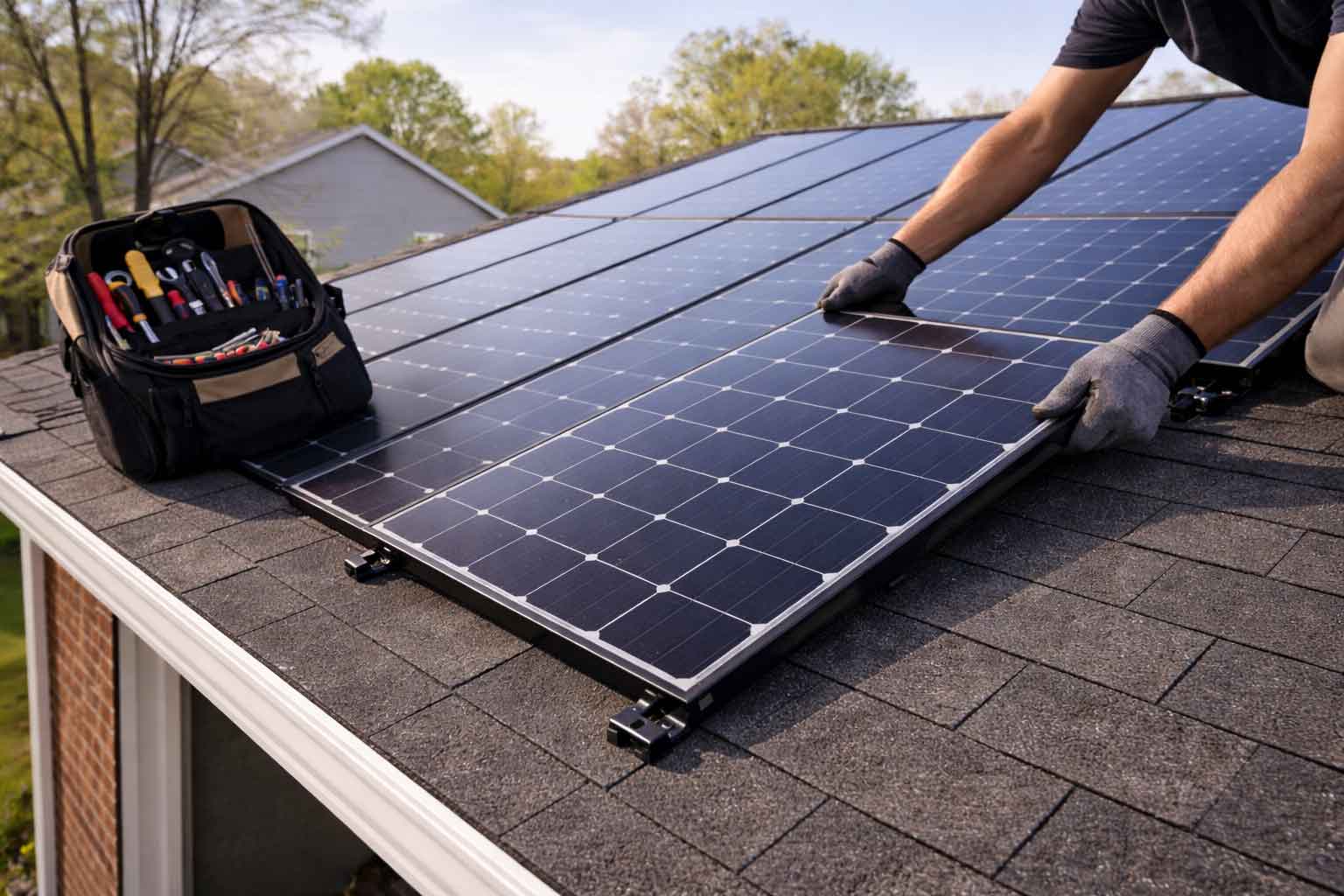
Hail damage, wind damage, broken glass, or a failed junction box can sometimes be handled by swapping only the affected modules.
This is usually easiest when your system has module-level electronics (like microinverters) because each panel operates more independently, so one problem module is less likely to drag down the entire array.
For string inverter systems, panel matching matters more. Mixing panel models with different electrical characteristics can create mismatch that reduces output for the whole string.
What to check before replacing panels:
- electrical specs (Voc, Vmp, Isc, Imp, temperature coefficients)
- physical size so the panel fits the existing racking layout
- connector type compatibility (MC4 and variants are common, but not always identical)
- whether your racking and clamps can accept the new module frame thickness
Practical homeowner takeaway: replacing a few panels can be a great fix, but “same watts” does not always mean “same fit” electrically.
3) Refreshing monitoring so the system reports correctly
Sometimes the system is working, but you lost visibility due to:
- gateway hardware aging out
- internet changes (router swap, mesh Wi-Fi, new ISP)
- discontinued cellular modules
- monitoring platform changes or account access problems
A monitoring refresh can be a high-value upgrade because it restores trust in the system and helps you catch real issues early. It can also clarify whether a “performance problem” is actually a home-usage problem.
4) Electrical panel work that helps your solar system play nicely with the house
If you’re already upgrading your electrical panel for a renovation, EV charger, generator, or a new HVAC setup, it’s a smart time to tidy up solar tie-ins, breaker sizing, labeling, grounding, and overall load planning.
This may not increase production, but it can remove bottlenecks and set you up for future solar expansion or battery storage.
5) Roof-related solar work during a reroof or major repair
If a roof replacement is coming, solar removal and reinstallation is often the moment to address:
- flashing and sealing details
- wire management and conduit protection
- critter guards (where appropriate)
- racking condition and fastener integrity
This is not a power upgrade, but it can prevent leaks and reduce long-term maintenance headaches.
Partial Upgrades That Can Work, But Need More Planning
Adding more panels to an existing system
Adding capacity can be possible, but it depends on:
- inverter headroom (AC rating) and string limits (DC voltage/current limits)
- roof space and structural considerations
- your main panel and service limits
- utility interconnection rules for modifications and expansions (paperwork and approvals can change based on system size and change scope)
- how your net metering credits apply after an expansion (varies by utility and program)
Two common approaches:
- expand onto the existing inverter only if it has real headroom and the string design stays within limits
- add a separate “add-on” array with its own inverter path (often cleaner when the original inverter is at capacity)
Practical homeowner takeaway: expansions are often doable, but they’re rarely a simple “add panels anywhere.” The electrical design has to make sense on paper, not just on the roof.
Switching inverter architecture
People consider switching designs when:
- shading patterns changed and they want better per-panel performance
- they want panel-level visibility for troubleshooting
- an old inverter failed and they want a different setup long term
This can be closer to a rebuild than a single-component upgrade because it may require:
- reworking module-level wiring
- changing rapid shutdown strategy
- swapping monitoring platforms
- revising conduit and junctioning
Practical homeowner takeaway: changing architecture can be worth it, but it usually isn’t “replace one box and walk away.”
Repowering: replacing most panels while keeping some infrastructure
Repowering usually means replacing much of the array with newer panels while trying to keep parts of the mounting or electrical path where it’s safe and permitted. This is often considered when:
- many panels are damaged or degraded
- the roof work timing makes a larger refresh sensible
- the existing layout is outdated and you want a cleaner design
Important reality: once the scope gets large, permitting and utility review are more likely to treat it as a major modification rather than a simple repair.
When a Partial Upgrade Often Does Not Make Sense
The system is aging and multiple parts are near end-of-life
If you replace one expensive component now and another expensive component soon after, piecemeal upgrades can cost more than a planned refresh.
Common red flags:
- repeated inverter faults or frequent disconnects
- multiple strings or many modules showing persistent underperformance
- damaged roof penetrations or recurring leaks around mounts
- brittle wiring, cracked conduit, corrosion, or water intrusion
- discontinued gear with no clean replacement path
Your roof is due soon
If the roof only has a few years left, a partial solar upgrade today can lead to paying for removal and reinstall twice. Planning solar work around the roof timeline often saves money and prevents frustration.
Your home load changed more than a partial upgrade can cover
If you added an EV, a heat pump, or other major load, a small solar expansion might not move the needle. In that case, it’s smarter to start with a usage review, then plan the right system size and upgrade path.
Homeowner Checklist Before You Approve a Partial Upgrade
Bring these questions to any installer:
- What exact problem are we solving: failure, expansion, monitoring, or future-proofing?
- Which parts stay, and which parts change?
- Will the new component be electrically compatible with what stays?
- Does this require new permits, inspections, or utility interconnection steps?
- Will monitoring change (new app, new portal, new gateway)?
- What happens to warranties for the parts that remain?
- If we do nothing else, what is the next likely failure point?
- If we expand now, will the utility treat it as a repair, a modification, or a larger re-interconnection?
If the plan can’t be explained clearly, slow down. Partial upgrades are only “simple” when the compatibility work is done up front.
A Few Real-World Scenarios
Scenario 1: Inverter failed, panels are fine
A common path is a compatible inverter replacement, updated monitoring, and a quick inspection of wiring and roof penetrations. Since many string inverters commonly need replacement during the panel life, this can be a normal lifecycle event, not a disaster.
Scenario 2: You need more capacity for an EV
Start by checking your usage and charging schedule. Then confirm whether your inverter and main panel can support an expansion. If the original inverter is at capacity, a separate add-on array with its own inverter path can be cleaner than forcing the existing system beyond its design limits.
Scenario 3: Your app is unreliable, but production looks steady
A monitoring refresh can restore visibility without touching the roof. This is often a good first move before spending money on major hardware.
Scenario 4: Roof replacement is coming
Plan the solar work around the roof job. This is often the moment when a larger refresh (layout cleanup, replacing older panels, updating mounts and flashing) makes more sense than a small partial change.
Getting Help With a Partial Solar Upgrade
If you’re considering a partial upgrade, the first step is confirming the change will solve the problem without creating new ones. We can review your current system, your goals, and what your equipment and utility setup will allow.
You’re welcome to call (844) 647-0401 or request a call back, and we’ll take care of you.
You can also schedule a consultation here.