

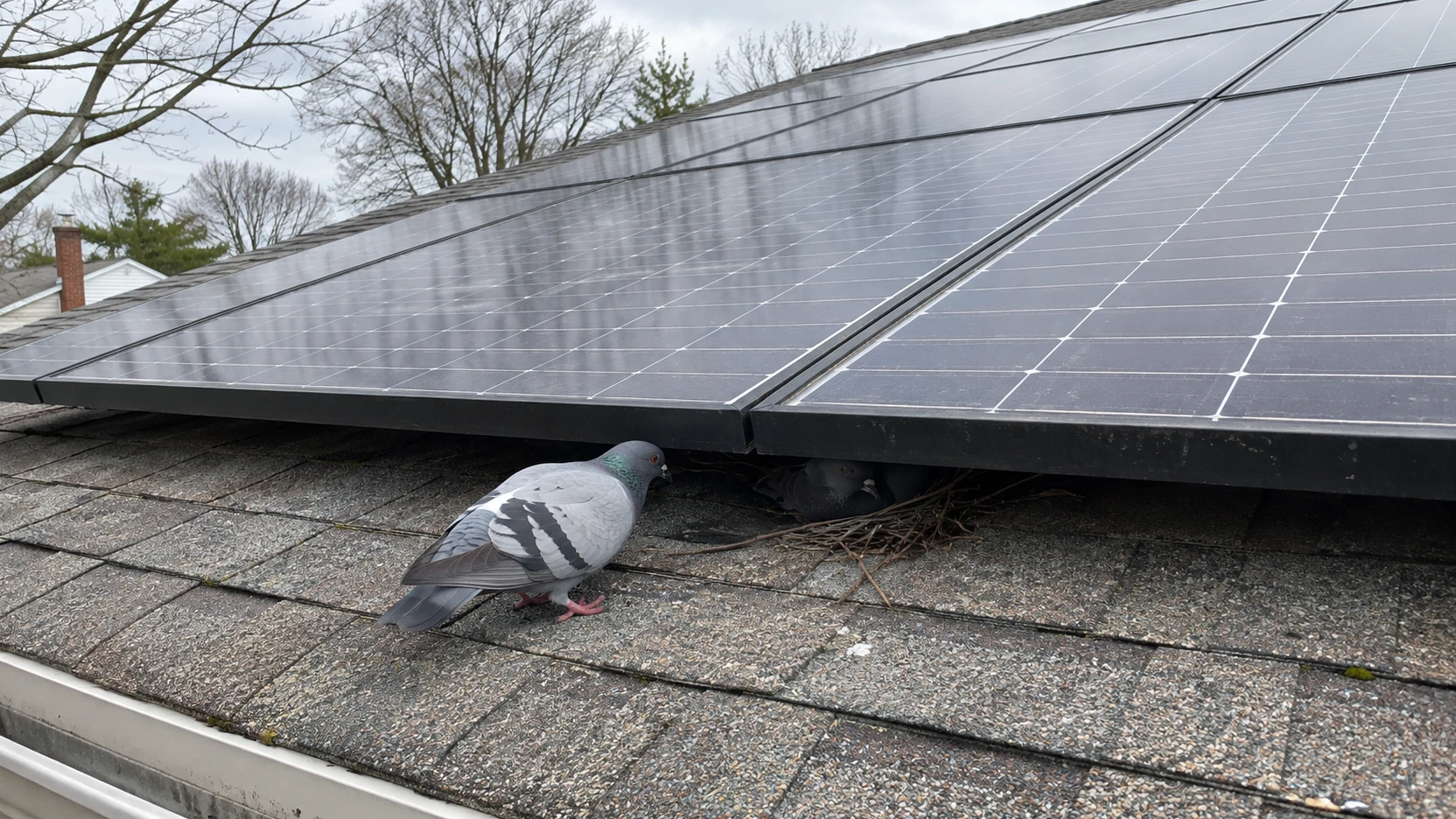
If you've started hearing cooing and scratching overhead, there's a good chance pigeons have found the gap under your solar panels.
To a pigeon, that gap is close to perfect: covered from rain and snow, warmed by the roof, and hidden from hawks. Here's what they leave behind, and how we close the gap they're using.
Why pigeons move in (and stay)
City pigeons, the gray "rock pigeons" you see all over New Jersey, originally nested on cliff ledges. A rooftop solar array (the full set of panels) gives them the modern version: a sheltered shelf a few inches off the roof.
Three things make the problem stick:
- They come back. Pigeons are loyal to a good nesting spot and return to it again and again.
- They nest year-round. Pigeons can raise several broods a year, so this isn't just a spring problem.
- One pair can become a group. A roof with an established nest can attract more birds over time.
What pigeons leave behind
Pigeons don't usually chew wiring the way squirrels do (that's covered in our solar critter damage guide). The trouble is what piles up:
- Nests and debris packed under the panels, often right around the wiring and connectors, holding leaves and moisture against the roof.
- Droppings on the glass that block sunlight and cut production. On systems wired in a series string, a dirty panel can drag down the others in that string, and heavy soiling can contribute to hot spots (small overheated areas on a panel).
- Mess everywhere else: gutters, windowsills, the patio, the car.
- Noise right above a bedroom ceiling.
There's also a health reason to skip the DIY cleanup. The CDC lists pigeons among the birds associated with histoplasmosis, a lung infection from a fungus that can grow in large, built-up piles of droppings. Disturbing a heavy accumulation is not a job for a broom and a ladder.
Why the quick fixes fail
Plastic owls and reflective tape stop working once pigeons get used to them. Hosing them out sprays water at your panels and wiring. Pulling nests by hand just clears the spot for the next pair. As long as the gap is open, they'll be back.
The fix: SolarMe critter guard
The long-term solution is to close the gap between the panels and the roof with a critter guard, a continuous band of aluminum mesh around the outside of the array. Our critter guard service follows five steps:
- Critter inspection. We look for nesting, droppings, chewing, and loose conduit (the tubing that carries wires) under and around the panels.
- Clean-out and sanitation. We remove nests and debris and sanitize the area if there's contamination.
- Repair any damage. We handle wiring repairs, re-terminations (redoing wire connections), and inverter or optimizer troubleshooting if anything was damaged.
- Install the guard. The mesh goes on without affecting airflow, which panels need to stay cool.
- Optional yearly check. We confirm the perimeter is still sealed and the system is producing what it should.
Most installs take just a few hours. If we find damage, we'll give you a repair timeline. Already have a guard and birds are still getting in? We inspect, repair, and re-secure existing guards too.
Is it legal to remove pigeons?
Generally, yes. Rock pigeons are on the federal list of birds the Migratory Bird Treaty Act does not cover, and New Jersey's wildlife rules exempt them as well. Most native birds are protected, though, so if you see eggs or chicks you don't recognize, tell us before anything is disturbed.
What does it cost?
It depends mostly on the size of your array, since the mesh runs around its whole outside edge, and on how much cleanup is needed if birds have already moved in. We'll scope your job and give you upfront pricing. Sealing the gap early typically costs less than repeated cleanups once a colony is established.
Frequently asked questions
Why are pigeons nesting under my solar panels?
The gap between the panels and the roof is sheltered, warm, and hidden from predators. Once pigeons settle in, they tend to keep coming back.
Do pigeons damage solar panels?
They usually don't chew wires, but their nests, debris, and droppings build up under and on the panels. Droppings on the glass can cut production.
What is solar panel bird mesh?
It's a band of metal mesh installed around the edge of the array to close the gap under the panels. It keeps birds and other critters out while still letting air flow.
Can I remove the pigeons myself?
We don't recommend it. Working on a roof around live electrical equipment is risky, built-up droppings carry a health risk, and the birds will return unless the gap is sealed.
Close the gap before the colony grows
Every month pigeons stay, the cleanup gets bigger. SolarMe will inspect your array, clear the nests, repair any damage, and seal the perimeter with aluminum mesh. Most guard installs take just a few hours.
Request your SolarMe critter guard inspection and get your roof back to quiet.
