

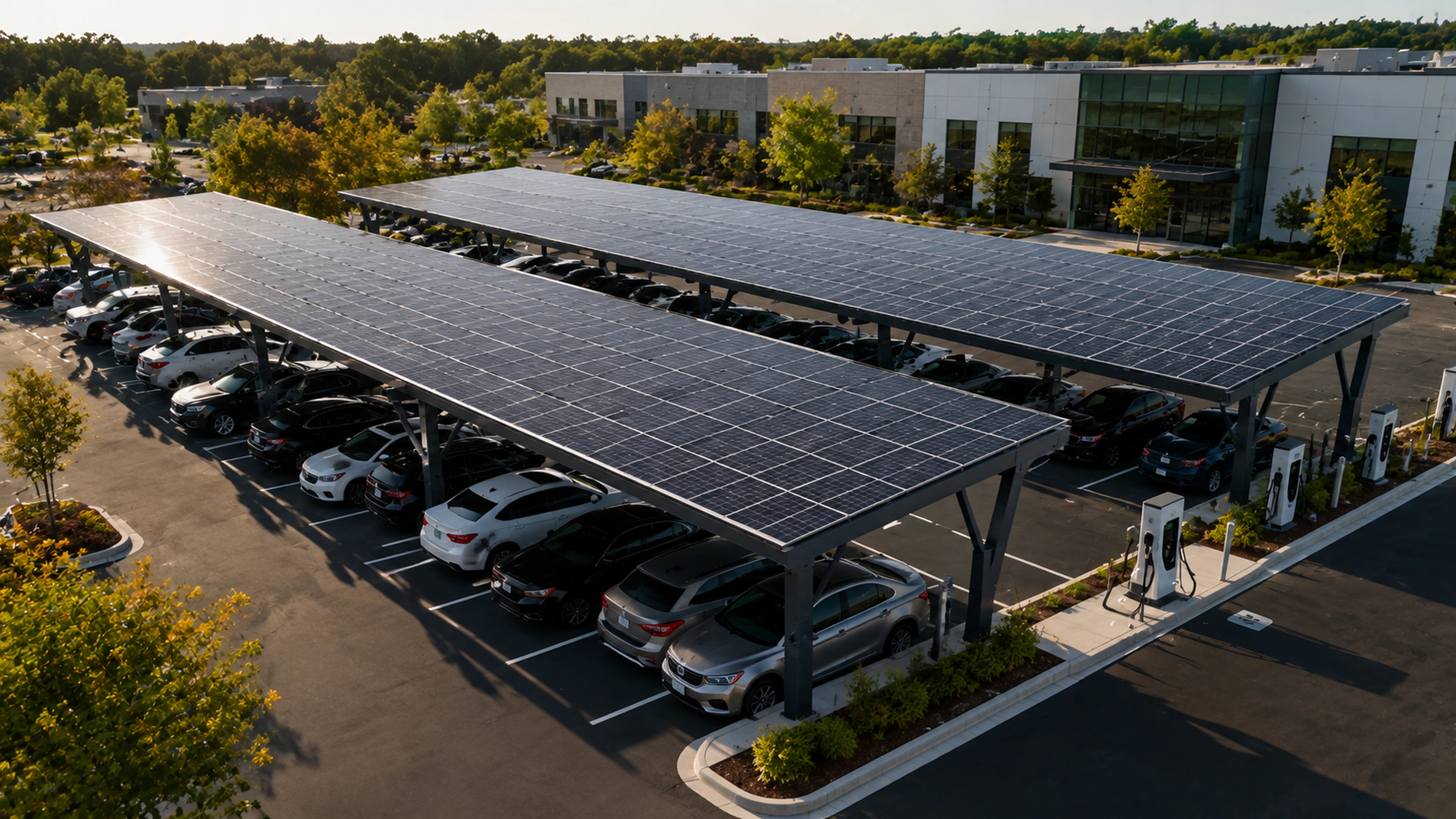
Walk out to your parking lot at noon in July. That asphalt is absorbing more sunlight than any surface on your property, and it's giving you nothing back except hot cars and faded paint.
A solar carport flips that. Steel canopies over the parking rows carry panels overhead, the cars underneath get shade and weather cover, and the building gets a power plant on land it already owns. For a lot of New Jersey businesses, it's a better fit than the roof. Here's the practical rundown: costs, incentives, sizing, and who gets the most out of one.
What a solar carport is (and isn't)
A solar carport is a purpose-built steel structure, typically a T-frame or cantilever design, that spans one or two rows of parking with panels as the roof surface. A parking garage canopy is the same idea on the top deck of a structured garage, including sloped decks. Both are distinct from a ground mount, which sits on open land rather than over parking.
Solar Me's commercial solar work covers all three. As the service page puts it, solar carports "optimize limited real estate and transform parking spots into renewable energy-generation machines," and if you're building a new garage, a solar canopy is a way to get more out of that investment from day one.
One boundary worth stating: this post is about commercial installations. The economics below assume a business-scale lot, a business-scale electric bill, and business tax treatment.
Why a carport instead of the roof?
Rooftop is usually the cheapest place to put commercial solar, and it should be the first thing you look at. Carports win in four situations:
1. The roof isn't right. Too small, too shaded by mechanicals, or too old. (If the roof is the problem, know that we'll replace a roof that isn't strong enough before installing panels, but sometimes the lot is simply the better site.)
2. You don't control the roof. Tenants, condo-style ownership, or a landlord who won't sign off. The parking lot may be yours when the roof isn't.
3. You want the tilt. Roof arrays follow the roof. A carport's panels are set at whatever angle produces the most, and the structure can be oriented for the sun rather than the building.
4. You want the visibility. A carport is a statement that customers, tenants, and employees see every day. That matters for retail, hospitality, schools, and healthcare, all of which are on the list of building types we serve.
The bonus everyone likes: shaded, dry parking. Cooler cars in summer, less snow to clear in winter, and covered walkways to the door.
What it costs
Carports cost more per watt than rooftop because you're building the roof as well as the array. Current marketplace data puts commercial carport installations at roughly $3.60 per watt, compared with about $2.60 per watt for rooftop (a simple, well-suited roof can come in lower). Fully engineered canopies with lighting, drainage, and EV infrastructure can run higher.
Concretely, a 250 kW carport, enough to cover a mid-sized lot, lands in the $900,000 range before incentives, versus roughly $650,000 for the same capacity on a suitable roof. That premium buys you a permanent structure, and it's exactly what the incentives below are designed to offset.
Sizing: how much power does a parking lot hold?
Rule of thumb: about 1.2 to 1.5 kW of panels per parking space when canopies span double rows, though the real figure depends on row layout and panel wattage. So:
- A 50-space lot supports roughly 60 to 75 kW
- A 100-space lot supports roughly 120 to 150 kW
- A 200-space lot or garage deck approaches 240 to 300 kW
Canopies need about 10 feet of clear height for passenger vehicles and more where fire lanes run beneath them, which is a design detail rather than a limitation. New Jersey has real examples at scale: Rutgers University has built more than 14 megawatts of solar carports across its campus parking lots.
Incentives in 2026: this is where the math turns
Federal investment tax credit (Section 48E). Commercial solar still qualifies for a federal credit of 30 percent of project cost when the project meets federal wage and apprenticeship standards for the installation crew, with additional 10 percent bonuses available for using enough American-made components and for projects in designated "energy communities" (areas with a history of fossil-fuel employment). The 2025 federal budget law added deadlines: solar projects generally need to have started construction by July 4, 2026 (a term with a specific legal definition, so ask before assuming you qualify), or be up and running by December 31, 2027, to claim the credit. New sourcing rules also restrict components from certain foreign manufacturers. If you're planning a carport, the 2027 date is the number to plan around, and it's why we'd suggest starting the conversation this year rather than next.
Bonus depreciation. The same law permanently restored 100 percent bonus depreciation for qualifying equipment, which means the bulk of a carport's cost can be written off in year one. Between the credit and depreciation, a large share of the project cost comes back in the first tax year.
New Jersey SREC-II, also called the ADI program. Every megawatt-hour the system produces earns a fixed state payment for 15 years on top of the electricity it offsets. Under the current program rules, non-residential systems under one megawatt on rooftops, carports, and canopies are grouped together at the higher rooftop-tier rate rather than the lower ground-mount rate, and public entities like schools and municipalities receive an additional bonus. The current values are in our SREC-II explainer.
Sales tax. Solar equipment is exempt from New Jersey sales tax.
Solar Me also offers payment plans and financing options for commercial projects, so the structure doesn't have to be a lump-sum decision.
Pairing it with EV charging
A carport is the natural home for EV charging, since the power source and the parking spot are the same piece of infrastructure. Adding commercial Level 2 charging typically runs $4,000 to $12,000 per port including the electrical work, less when the conduit goes in with the canopy instead of being trenched in later. Solar Me handles commercial EV charging systems from permitting through installation, and a canopy project is the cleanest time to run that conduit.
Who it makes sense for
The best carport candidates in New Jersey share a profile: a lot of parking, meaningful daytime electricity use, and a roof that's either unavailable or unsuitable. In practice that's:
- Schools and municipal buildings, which also collect the public-entity incentive adder
- Retail and strip malls, where the canopy doubles as customer amenity
- Healthcare facilities and hotels, with round-the-clock loads and visitor parking
- Offices and corporate campuses with sustainability commitments and employee EVs
- Warehouses whose roofs are already full or committed, with employee lots sitting open
If the roof is available and sound, start there; our commercial solar guide covers the rooftop path. If it isn't, the parking lot is the next best roof you own.
Frequently asked questions
How much does a solar carport cost?Commercial solar carports currently run about $3.60 per watt installed, versus roughly $2.60 per watt for rooftop, because the steel canopy is part of the project. A 250 kW carport is in the $900,000 range before the federal credit, depreciation, and New Jersey incentives.
Is a solar carport worth it for a business?Often, yes, when the roof is unavailable or unsuitable and the business has significant daytime load. The 30 percent federal credit, 100 percent bonus depreciation, and 15 years of SREC-II payments offset the structure premium, and the shaded parking is a tenant and customer amenity.
How many solar panels fit over a parking lot?About 1.2 to 1.5 kW per parking space with double-row canopies. A 100-space lot supports roughly 120 to 150 kW.
Do solar carports qualify for the federal tax credit in 2026?Yes. Commercial solar, including carports, remains eligible for the Section 48E credit, generally 30 percent when the crew is paid at federal prevailing wage rates, subject to the current construction-start and completion deadlines. Projects should plan around having the system up and running by December 31, 2027.
Can I add EV chargers to a solar carport?Yes, and it's the ideal time to do it. Commercial Level 2 charging typically adds $4,000 to $12,000 per port including electrical work, and running the conduit with the canopy keeps that toward the low end.
Let's look at your lot
Bring us a site plan and a recent electric bill, and we'll tell you what your parking lot could produce, what it would cost after incentives, and whether the roof or the lot is the smarter first move. Request a commercial assessment to get started.
