

Somewhere in the back of every homeowner's mind, there's a small voice asking whether bolting an electrical generator to the roof is a good idea. It's a fair question, and it deserves a plain answer rather than a brush-off.
Here it is: rooftop solar fires are rare, and when they do happen, the cause is almost always something a good installer or inspector would have caught. Modern electrical code has spent the last decade closing the gaps that caused the early incidents. Let's walk through the actual numbers, the actual causes, and what a professional looks for.
How rare are solar fires, really?
The best long-term data comes from Germany, which installed solar earlier and at larger scale than the United States. A study by the Fraunhofer Institute looked at roughly 1.3 million systems and found about 120 fires where the solar equipment itself was the cause. That works out to well under one hundredth of one percent of installations. A UK government-commissioned review of solar fire incidents reached similar conclusions about what causes them.
Two more points from that research matter for homeowners. First, most solar-related fires stay confined to the equipment itself and never reach the house. Second, roughly a third of the incidents studied were traced directly to installer error, with the rest split among design mistakes, faulty parts, and cases where the cause couldn't be pinned down. Translation: the risk lives mostly in the workmanship, not in the technology.
The three causes behind almost every solar fire
1. Bad DC connectors. The plug-style connectors that link panels together (usually called MC4 connectors) are the most commonly cited cause in fire investigations. Mixing connector brands, crimping them poorly, or leaving them partially seated creates resistance, and resistance creates heat. Over a few summers, a hot connector can char its housing and eventually arc.
2. Arc faults in damaged wiring. A cracked cable jacket, a wire pinched under a rail, or insulation chewed by squirrels can let electricity jump a gap. That jump is an arc, and an arc is essentially a tiny welding torch. Rodents are a real New Jersey problem, which is why we wrote about critter damage as its own topic.
3. Overheated or failing components. An inverter starved of ventilation, a corroded DC isolator (the manual cutoff switch on the wall), or a power optimizer (the small electronics box under each panel on some systems) that fails internally. These are less common than connector problems, and most modern equipment shuts itself down when something is wrong. Our guide to solar inverters explains what each of those components does.
Notice what's not on the list: the panels themselves. A solar panel is glass, aluminum, and silicon. It doesn't spontaneously ignite.
What the electrical code requires in New Jersey
New Jersey's building code currently enforces the 2020 edition of the National Electrical Code (the NEC), and newer editions get adopted over time. Two sections of that code do most of the safety work:
Rapid shutdown (NEC 690.12). Every rooftop system installed under modern code must be able to drop the voltage on its roof wiring to a safe level within 30 seconds of a switch being thrown. That's what lets a firefighter cut power at the ground and work on the roof without stepping on a live 400-volt circuit. On most New Jersey homes this is handled at the panel level: Enphase microinverters and SolarEdge optimizers both satisfy the rapid shutdown rule by design, because each panel's electronics go dormant the moment the system is shut off.
Arc-fault protection (NEC 690.11). Rooftop systems must include a sensor that recognizes the electrical signature of sparking inside the wiring and shuts that circuit down automatically, before the spark becomes a fire. Think of it as the solar version of the arc-fault breakers now required in bedrooms.
The fire code adds a third layer: clear pathways on the roof, typically about three feet wide, so firefighters can move around the array and vent the roof if they ever need to.
If your system went in more than about eight years ago, it may predate the panel-level rapid shutdown rules, depending on when your town's code caught up. That doesn't make it dangerous, but it does mean it deserves a closer look than a newer system.
Warning signs worth a phone call
Most problems announce themselves before they become emergencies. Call someone if you notice:
- A burning or "hot plastic" smell near the inverter or the roofline
- Scorch marks, melted housings, or discolored connectors visible from the ground or attic
- The inverter throwing ground fault, arc fault, or insulation errors you can't clear
- Production dropping sharply on a single string or panel with no obvious shading cause
- Evidence of animals nesting under the array
None of these should be ignored, and none of them should be investigated by climbing on the roof yourself. Turn the system off at the disconnect if you smell burning, then make the call.
What a professional safety check actually involves
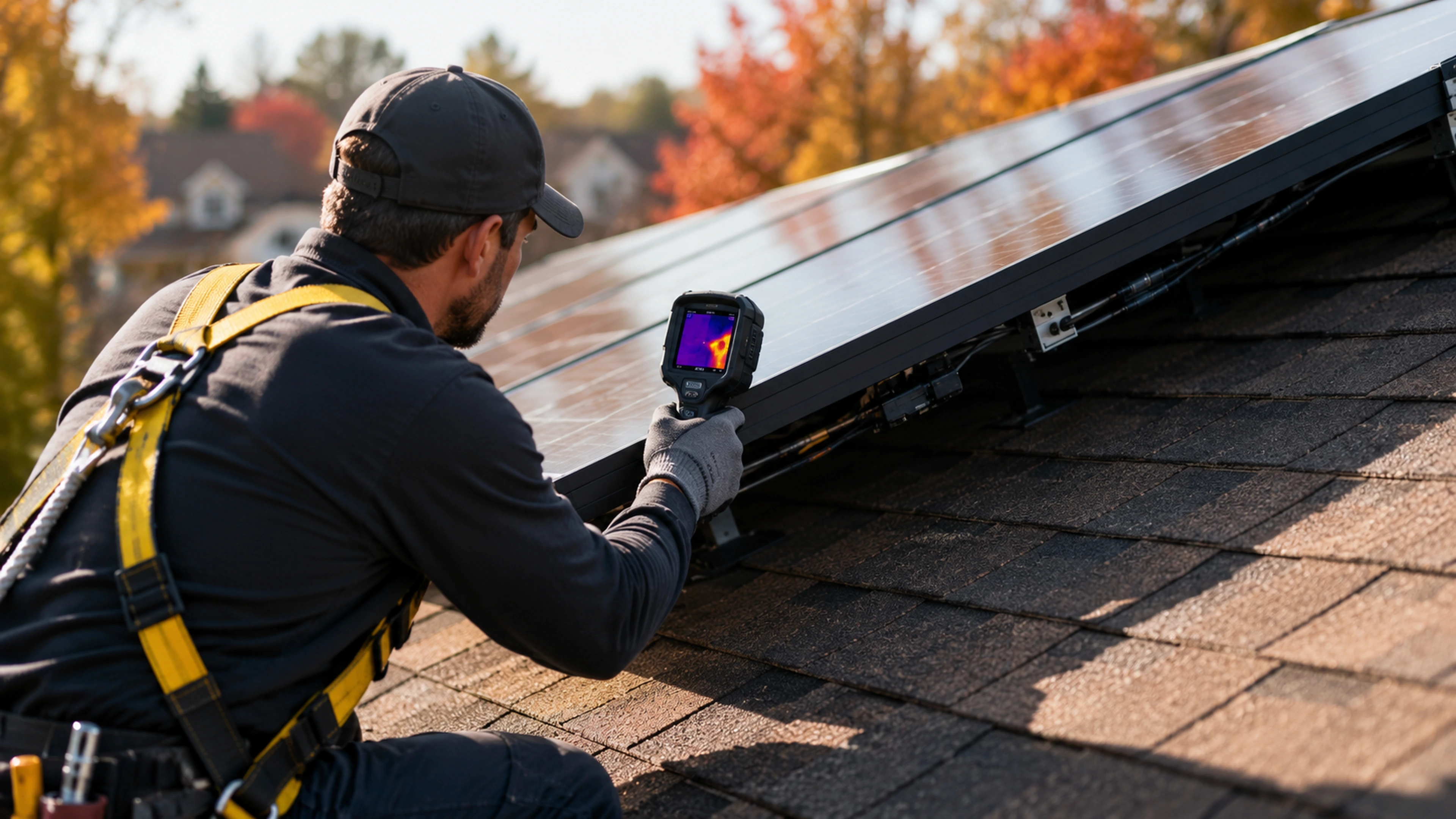
This is where the difference between "looks fine from the driveway" and "verified safe" shows up. A proper diagnostic visit at Solar Me includes an on-site inspection with testing of the inverters, wiring, and module-level output, using a multimeter and thermal sensing to find the hot spots a camera can't see. That thermal scan is the single most useful fire-prevention tool in the kit, because a connector that's running 40 degrees hotter than its neighbors is a problem you can fix on a Tuesday afternoon instead of a problem the fire department fixes at 2 a.m.
From there, you get written findings that spell out what's working, what's failing, and what needs attention, along with transparent pricing for any repairs: connector replacement, wire repair, critter damage, optimizer swaps, or inverter replacement.
We covered the broader question of when an inspection is worth scheduling in What Happens During a Professional Solar Inspection. The short version for safety purposes: after any storm that could have shifted panels, if you've bought a home with an existing system, and, importantly, if your original installer is out of business and nobody has looked at the system in years. Orphaned systems are where deferred maintenance hides, which is exactly why we offer orphaned system takeover.
Frequently asked questions
Are solar panels a fire hazard?Not in any meaningful sense. Long-term studies of over a million installed systems put the rate of solar-caused fires at a small fraction of one percent, and most of those stayed confined to the equipment. Nearly all trace back to installation quality or damaged wiring, not the panels.
What is rapid shutdown on a solar system?A code-required feature that drops roof wiring to a safe voltage within 30 seconds of shutting the system off, so firefighters can work safely. Microinverter and optimizer systems (Enphase, SolarEdge) meet the rule at the individual panel level.
Can lightning cause a solar panel fire?Direct strikes on panels are very rare. Properly grounded and bonded systems, which the code requires, route surge energy safely to ground. Lightning is a far bigger threat to unprotected electronics inside the house than to a bonded rooftop array.
What causes most solar panel fires?Poorly made or mismatched DC connectors, arc faults from damaged or rodent-chewed wiring, and overheated components like inverters or isolator switches. Installer error accounts for more incidents than product defects.
How often should a solar system be checked for safety?There's no fixed rule, but a diagnostic check after severe storms, when buying a home with solar, or every few years on an older system is reasonable. Thermal imaging of the connectors and wiring is the most effective way to catch a developing problem early.
Peace of mind is a phone call away
If you've ever wondered whether your system is as safe as the day it was installed, that's reason enough to have it looked at. Request a diagnostic visit and we'll test the wiring, scan for hot spots, and put what we find in writing.
