

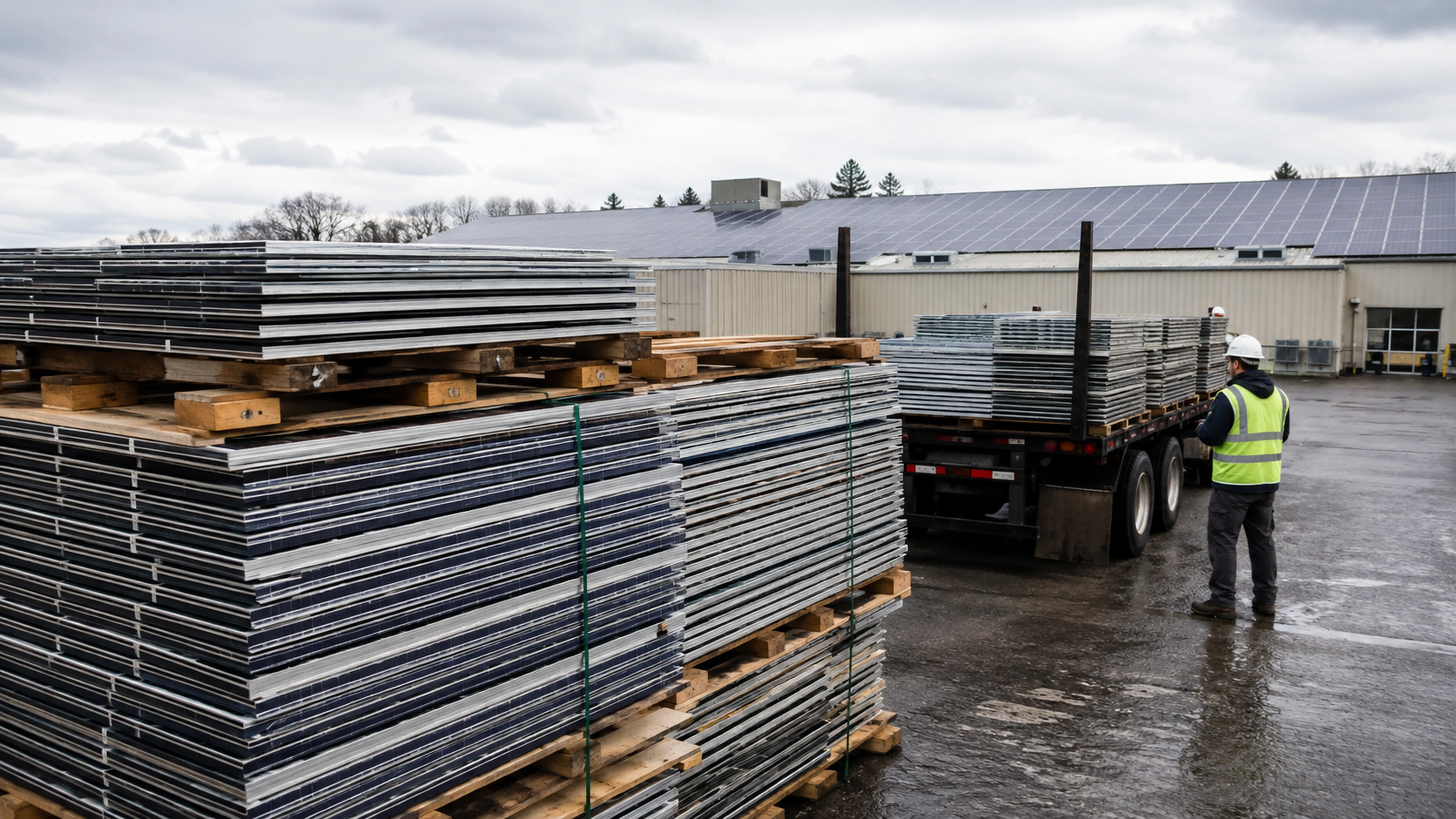
Solar has been on New Jersey roofs in real numbers since the late 2000s, which means the first big wave of systems is now 15 to 20 years old. They're still working, mostly. But the question of what happens to a panel when it's finally done is no longer theoretical, and search interest in "solar panel recycling" has roughly increased tenfold over the past year.
So here's the full answer: what a panel is made of, what a recycler can actually recover, what New Jersey now expects of system owners, what it costs, and how a professional decommissioning works when the day comes.
First, when is a panel actually "done"?
Later than most people assume. Panels carry 25-year warranties and degrade at roughly half a percent per year, so a 20-year-old panel is still producing 85 to 90 percent of what it did new. We covered the aging curve in How Long Do Solar Panels Last.
In practice, panels leave a roof for one of five reasons, and only the last one is old age:
- Storm or physical damage to individual panels (what to check after a storm)
- Repowering, swapping a 2010-era array for fewer, more powerful modern panels
- Building changes: a demolition, a major addition, a roof that's being replaced
- End of a lease or PPA where the owner elects removal
- True end of life, usually 30-plus years in
For a single failed panel, the right move is often repair or one-for-one replacement rather than anything dramatic, as we explained in Solar Panel Replacement in NJ. Full decommissioning is for when the whole array is coming down.
What's inside a solar panel
By weight, a typical silicon panel is about 75 percent glass. Add the aluminum frame and you're at roughly 90 percent of the panel. The remainder is the silicon cells themselves, copper wiring, a small amount of silver in the cell contacts, the plastic backing and the clear laminate that holds the layers together, and trace amounts of lead in the solder.
That composition is why the recycling conversation is more hopeful than it sounds. Glass and aluminum are among the most recyclable materials on earth. The industry estimates that about 95 percent of a panel's material is recoverable, and the newer dedicated recycling facilities recover 90 percent or more by weight. The hard part is separating the layers, which are laminated together precisely so they never come apart on your roof.
How panels are actually recycled
Old-school recycling meant shredding panels and recovering the glass and aluminum, while the valuable-but-tiny silver and silicon fractions went to waste. That's changing. Purpose-built solar recyclers now run processes that delaminate the panel, recover the glass clean enough to go back into new panels, and pull out the silver, copper, and silicon separately.
Capacity is scaling up fast. SOLARCYCLE started up a Georgia facility in early 2026 with a design capacity of roughly 10 million panels a year once fully ramped, and the Solar Energy Industries Association runs a national program (searchable at SolarRecycle.org) that connects panel owners with vetted recyclers. New Jersey also has its own commercial solar recyclers.
The cost question, honestly
This is the part the industry is still working through. Recycling a panel currently costs somewhere between $10 and $40, depending on the recycler, the volume, and the transport distance. Sending the same panel to a landfill costs a few dollars. That gap explains why, nationally, only a small fraction of retired panels have historically been recycled.
Two things are closing the gap: the recovered materials are worth more as recyclers get better at extracting them, and states, New Jersey among them, are starting to require recycling rather than leave it to price alone.
What New Jersey requires
New Jersey has been ahead of most states here. A 2019 law created the New Jersey Solar Panel Recycling Commission, which issued its final report in late 2023 recommending that the state classify end-of-life panels as "universal waste," a simpler category than hazardous waste, meaning panels could be collected and recycled without the paperwork burden that hazardous waste carries. The Department of Environmental Protection has been working through that reclassification.
Then, in January 2026, New Jersey became the first state to enact a law (S3399) requiring owners of solar systems to have panels removed and recycled at the end of their use rather than landfilled, with the DEP writing the implementing rules. The specifics are still being finalized as of this writing, so if you own a commercial array, expect documentation showing where each panel went to become standard rather than optional.
At the federal level, the EPA evaluates whether a panel counts as hazardous waste using a leaching test for lead and cadmium. Many modern panels pass; some older ones don't. The EPA has proposed adding panels to the federal universal waste rule but hasn't finalized it. The practical upshot: don't put panels in the dumpster. Handle them through a recycler or a decommissioning contractor that documents where they went.
How a professional decommissioning works
Taking down a solar array isn't demolition. It's a live electrical system connected to the utility grid, and the panels keep producing voltage as long as the sun is up, even when they're disconnected. That's why Solar Me's commercial decommissioning follows a documented process:
- Site assessment and planning, with full documentation of the existing system
- Utility and permitting coordination, so the system is shut down legally and the utility formally closes out its connection to the grid
- Safe shutdown using OSHA and NEC compliant lockout/tagout procedures (the system is physically locked off so it can't be re-energized while crews work)
- Equipment removal: panels, racking, inverters, conduit, and hardware
- Logistics and transportation to the right destination
- Recycling and documentation, with chain-of-custody records (paperwork proving where each panel went) if you need them
On what happens to the equipment, the service page puts it plainly: we coordinate recycling, resale, or proper disposal based on condition and your preference. Panels in good shape can have a second life; damaged or obsolete ones go to a recycler, and you get the paperwork proving it.
For a deeper look at the process and when you need it, see Solar Decommissioning: What It Is, When You Need It, and How It's Done Right.
What about a home system?
Residential arrays are smaller, but the principles are identical. If your panels need to come off for a roof replacement, our removal and reinstallation service handles them and puts them back. If a panel has failed outright, a diagnostic visit confirms whether it's the panel or something upstream before anything gets replaced. And if a home system is truly at the end of its life, the same safe-shutdown and responsible-disposal process applies, just at a smaller scale.
Frequently asked questions
Can solar panels be recycled? Yes. About 95 percent of a panel's material, mostly glass and aluminum, is recoverable, and dedicated solar recyclers now recover the silicon, silver, and copper as well. The main barrier has been cost, not technology.
What happens to old solar panels? Panels in good condition are often resold or repurposed. Damaged or obsolete panels go to a recycler that separates the glass, aluminum, and metals. Landfilling is increasingly restricted, and New Jersey is moving to require recycling.
How much does it cost to recycle a solar panel? Roughly $10 to $40 per panel today, depending on volume and transport, versus a few dollars to landfill. Costs are falling as recycling capacity grows and recovered materials gain value.
Are solar panels hazardous waste? It depends on the panel. The EPA uses a leaching test for lead and cadmium; many modern panels pass, some older ones don't. New Jersey has been working to classify end-of-life panels as universal waste to simplify collection. Either way, they should go through a recycler, not a dumpster.
How long do solar panels last before they need to be recycled? Typically 25 to 30 years or more. Most panels leave a roof early for other reasons, like storm damage, repowering, or building changes, rather than wearing out.
Planning a removal or a decommissioning?
Whether it's a warehouse array that's reached the end of a lease or a home system coming off for a new roof, request an assessment and we'll walk you through shutdown, removal, and where every panel ends up.
