

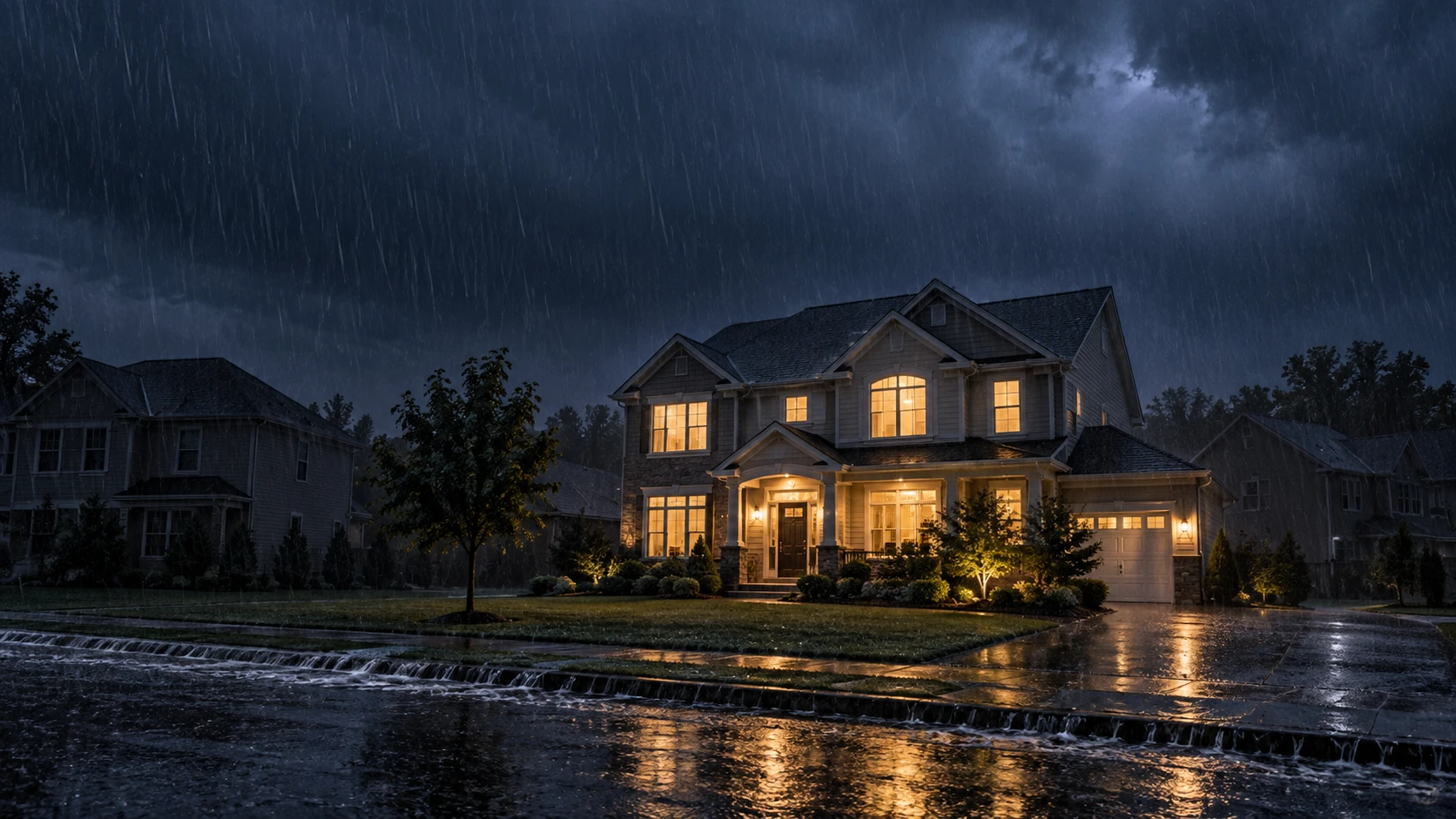
Here's the frustrating thing about sump pumps: the storms most likely to flood your basement are also the storms most likely to knock out your power. And a sump pump without power is just a hole in the floor.
New Jersey knows this well. The state's own hazard plan calls flooding the most frequent natural hazard in New Jersey, and notes that high groundwater can cause basement problems even when there's no flooding on the street. If your home depends on a sump pump, keeping it powered through an outage is one of the smartest things you can plan for.
This guide compares the two whole-home options we install, a home battery and a standby generator, and how each one handles a sump pump.
First, why solar panels alone won't save you
If you already have solar, it's natural to think you're covered. You're not, at least not without a battery. A standard grid-tied solar system shuts itself off during a power outage. That's a safety rule, so your panels don't send electricity into power lines that utility crews are working on. We explain it fully in do solar panels work during a power outage.
To keep anything running during an outage, including your sump pump, you need either a battery or a generator.
How much power does a sump pump need?
Less than most people think, but with a catch.
Typical figures from Honda's generator wattage guide:
Pump sizePower while runningPower to start1/3 horsepowerabout 800 wattsabout 1,300 watts1/2 horsepowerabout 1,050 wattsabout 2,150 watts
The catch is that starting burst. Like any motor, a sump pump needs a quick jolt of extra power to get going, often about double its running power. Any backup system has to handle that surge, not just the running number. Check the label on your own pump, since models vary.
Sump pumps also don't run constantly. They turn on, empty the pit, and shut off. In a heavy storm, that might mean running for a short burst every few minutes.
A rough example: if a 1/2 horsepower pump ends up running about 15 minutes out of every hour during a long storm, that adds up to around 6 hours of pumping a day, or roughly 6 kWh of electricity. A lighter storm might use 2 kWh or less. On a day with very high groundwater, it could be more. These are estimates to give you a feel for it. Every basement is different.
Option 1: A home battery
A home battery stores electricity and switches on automatically, almost instantly, when the grid goes down. You may not even notice the outage.
How it handles a sump pump:
- A Tesla Powerwall 3 stores 13.5 kWh and is built to start large motors like central air conditioners and well pumps, so a typical sump pump's starting surge is well within its range. Using the example above, a single Powerwall 3 could run a sump pump through a long storm day with plenty left for your refrigerator, lights, and Wi-Fi.
- Smaller batteries, like Enphase's IQ Battery 5P, store 5 kWh each. On paper, one can start a typical sump pump, but 5 kWh goes quickly if the pump shares it with a fridge and other circuits. Multiple Enphase batteries can be combined for more storage.
The big advantage with solar: during a multi-day outage, solar panels can recharge the battery whenever the sun comes out. Enphase batteries also have a Storm Guard feature that charges the battery to full when the National Weather Service issues a severe weather warning, so it's ready before the storm hits.
The limits: a battery holds a set amount of energy. During a long, cloudy storm with little sun to recharge it, you'll want to keep the battery focused on essentials like the sump pump and fridge, not the dryer and the air conditioner. That's why many battery setups back up a panel of essential circuits, and the sump pump should be on it.
Other perks: batteries are silent, need no fuel, and require very little upkeep.
Option 2: A standby generator
A standby generator is permanently installed outside your home and connected to your natural gas line (or a propane tank). When the power goes out, it starts automatically and takes over your home's power, usually within seconds to a minute or two.
How it handles a sump pump:
- It doesn't run out. A natural gas generator can keep running as long as gas keeps flowing, which is a real advantage in a multi-day outage when there's little sun.
- Starting surge isn't a problem. Even a smaller home generator has far more power than a sump pump needs to start.
- It covers everything else too. A properly sized generator can run your sump pump alongside the furnace, fridge, and often the whole house. See what size generator you need for how sizing works.
The trade-offs: a generator makes noise when it runs, needs regular maintenance like any engine, and runs a short self-test on a schedule to make sure it's ready. With Generac's Mobile Link, you can check your generator's status from your phone.
A safety note: never run a portable generator inside a home, basement, or garage, or near windows or doors. The CDC warns that carbon monoxide from generators can kill, and says to keep them at least 20 feet from windows, doors, and vents. A permanently installed standby generator sits outdoors, placed with the clearances from windows, doors, and vents that the manufacturer and local codes require.
Battery vs. generator: side by side
Home batteryStandby generatorSwitches onAlmost instantlyWithin seconds to a minute or twoHow long it runsUntil the stored energy runs out, or longer if solar recharges itAs long as natural gas or propane is availableNoiseSilentNoticeable while runningFuelNoneNatural gas or propaneUpkeepVery littleRegular engine maintenanceWorks with solarYes, solar can recharge itRuns separately from solarBest forSolar homes, quiet backup, shorter or sunny outagesLong outages, whole-home power, homes without solar
Some homeowners use both. For a deeper comparison, read standby generator vs. solar battery backup in NJ.
What does each cost?
Prices depend on your home, but industry numbers give you a starting point:
- A whole-home standby generator (around 22kW) commonly runs roughly $9,000 to $18,000 installed in New Jersey, depending on the gas line, electrical work, and site.
- A Tesla Powerwall 3 commonly runs roughly $13,000 to $16,000 installed for one unit before incentives.
- Smaller batteries cost less per unit and can be added in stages.
Incentives in 2026: the federal tax credit for home batteries ended for systems installed after December 31, 2025. PSE&G customers may qualify for PSE&G's GridSmart Battery Program, announced in August 2026, which offers a $5,000 instant rebate and interest-free repayment on your bill for qualifying batteries installed through participating contractors. New Jersey's Board of Public Utilities has also proposed a statewide home battery program, but it isn't open yet.
Which one is right for your basement?
- You have solar or are planning it: a battery usually makes the most sense. It uses the panels you already paid for and can recharge during an outage.
- Your area loses power for days at a time: a natural gas generator's unlimited runtime is hard to beat.
- You want quiet, hands-off backup: a battery.
- You want to run the whole house, including central air, through any outage: a properly sized generator, or a larger battery system.
Either way, make sure your sump pump is on the backed-up circuits. It sounds obvious, but it's the one appliance that can turn a power outage into a flooded basement.
Frequently asked questions
Will a home battery run my sump pump during a power outage?Yes, if the sump pump is on a backed-up circuit. A typical sump pump uses about 800 to 1,050 watts while running, well within what home batteries like the Tesla Powerwall 3 can supply.
What size generator do I need for a sump pump?A sump pump alone needs very little, about 1,300 to 2,150 watts to start. Most people size a standby generator for the whole list of things they want running, and the sump pump is one small part of it.
How long will a battery run a sump pump?It depends on how often the pump runs. In a heavy storm, a pump might use roughly 2 to 6 kWh a day. A 13.5 kWh Powerwall 3 could cover that with room for other essentials, and solar can recharge it during the day.
Do solar panels power my sump pump in an outage?Not by themselves. Grid-tied solar shuts off in an outage for safety. You need a battery to keep using solar power when the grid is down.
Is a generator or battery better for flooding?Both work. Generators run as long as fuel flows, which helps in long outages. Batteries are silent, switch on instantly, and recharge from solar. The best choice depends on how long your outages last and whether you have solar.
Keep your basement dry, even when the lights go out
We install home battery systems, including Tesla Powerwall, and Generac standby generators across New Jersey. Request a free consultation and we'll look at what your home needs to keep running, starting with the sump pump.
