

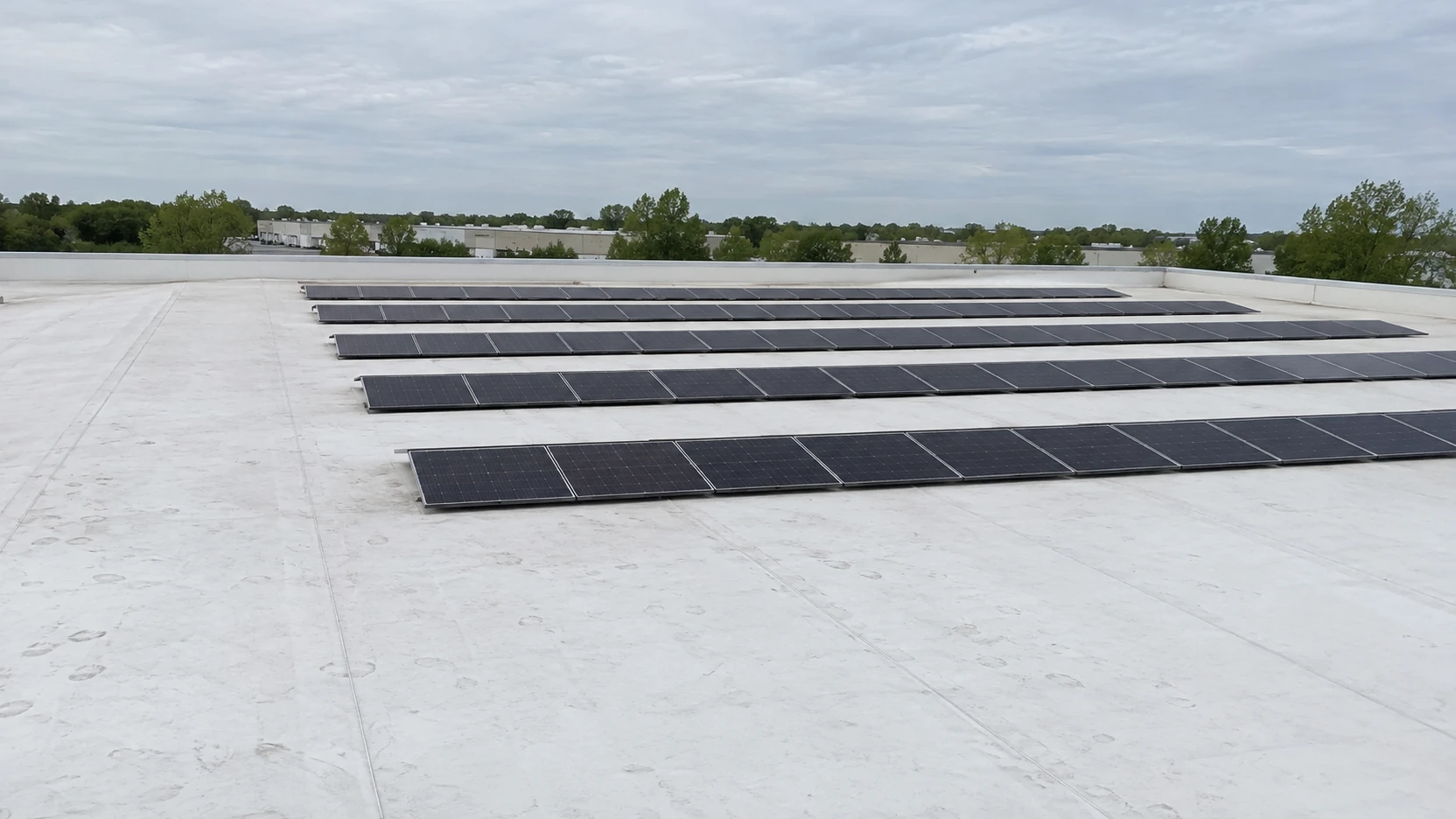
Commercial solar panels are built to produce power for decades. Many commercial roofs aren't. Putting a new array on a roof with only a few good years left can turn into a costly mistake: when that roof fails, the panels have to come off before it can be replaced, then go back on.
That's why our commercial solar page says it plainly: if your roof is not strong enough for solar panels or risks future damage, we will replace it before installing the panels and inverters.
The lifespan math
Quality solar panels typically carry performance warranties (a guarantee the panels keep a set share of their output) of 25 years or more. Common flat commercial roofs have shorter typical lifespans. InterNACHI, the home inspectors' association, estimate
s:
- TPO (white single-layer membrane): 7 to 20 years
- EPDM (black rubber membrane): 15 to 25 years
- Modified bitumen (asphalt-based rolls): about 20 years
- Built-up roof (layers of asphalt and felt): about 30 years
Real-world life depends on thickness, installation, drainage, and maintenance. Even so, a membrane that's already 10 or 15 years old may not outlast a new array.
What "doing it later" costs
- Labor to remove and reinstall every panel, plus the racking (the metal frame the panels sit on) and wiring
- New hardware where old parts can't be reused
- Permits and inspections, typically required again before restart
- Lost production, meaning higher utility bills while the system is down
- Lost incentive income. New Jersey's SuSI program pays registered commercial systems for each megawatt-hour they generate, so no production means no payments.
For homes, removal and reinstallation commonly runs a few hundred dollars per panel, so on a commercial array with hundreds of panels, a mid-life roof replacement can add tens of thousands of dollars and weeks of downtime.
How to tell if your roof should go first
A proper assessment looks at more than age:
- Membrane condition: seams, blisters, cracks, punctures
- Trapped moisture in the insulation, found with infrared scans or small test cuts
- Drainage: standing water ("ponding") shortens roof life and gets worse under panels
- Structure: whether the building can carry the array plus New Jersey snow loads, confirmed by a structural review
- Existing roof warranty and what it requires before anything is mounted
The rule of thumb: if the roof isn't likely to outlast the array by a comfortable margin, replacing it first is usually cheaper over the life of the system.
How solar mounts on a flat roof
Ballasted systems hold the racking down with concrete blocks instead of bolting through the roof: fewer penetrations, more weight. Attached systems anchor to the structure, with each attachment sealed into the membrane with waterproof flashing. Many projects use a mix. Either way, a new roof gives the array a clean, dry, solid base. See which roofs work with solar for more.
What commercial roof replacement costs
Prices vary widely with roof size, membrane, insulation, and access. Consumer cost guides put TPO roofing at roughly $4 to $10 per square foot installed, plus about $1 to $2 per square foot to tear off the old roof. At those rates, a 20,000 square foot roof would come to roughly $100,000 to $240,000. Large commercial roofs can price differently, and insulation, drainage, or damaged decking (the structural deck under the roof) can push it higher. These are industry ranges, not our pricing.
Why timing matters right now
The federal commercial solar tax credit (Section 48E, typically 30% for projects that meet its labor requirements or are small enough to be exempt) is still available on a deadline. Projects that didn't begin construction by July 4, 2026 now generally need to be placed in service (installed and operating) by December 31, 2027. A roof replacement adds time, so planning both together protects that deadline. Details are in the commercial solar tax credit after July 4, 2026.
The solar credit generally covers the solar equipment, not the roof. Separately, federal tax law allows businesses to expense certain nonresidential roof replacements under Section 179, subject to limits. Ask your tax advisor how both should be treated.
Frequently asked questions
Should I replace my commercial roof before installing solar?
If the roof is unlikely to outlast the array, yes. Replacing it later means removing and reinstalling the array, new permits, and lost production.
How long does a commercial flat roof last?
InterNACHI estimates roughly 7 to 20 years for TPO, 15 to 25 for EPDM, about 20 for modified bitumen, and about 30 for built-up roofs.
Does the commercial solar tax credit cover a new roof?
Generally, no. The 48E credit applies to the solar equipment. Some businesses can expense nonresidential roof replacements under Section 179.
Can solar go on a flat roof without drilling holes?
Often, yes. Ballasted systems use weights instead of penetrations, but they add load, so a structural review is needed.
One project, one plan, one roof that lasts
SolarMe designs and installs commercial solar on New Jersey rooftops larger than 10,000 square feet, and if your roof isn't ready, we replace it before the panels and inverters go on. To be placed in service by the December 31, 2027 deadline, the roof has to be on the schedule first.
Request your SolarMe commercial solar assessment and find out whether your roof is ready to carry the next 25 years.
