

If you've heard that "the solar tax credit is gone," you heard half the story. The federal credit for homeowners ended at the end of 2025. The federal credit for businesses is still very much alive in 2026.
But it now comes with a deadline. For most new commercial solar projects, the system has to be finished and running by December 31, 2027. That's why businesses thinking about solar should start the conversation now, not next year.
Here's what New Jersey business owners, property managers, schools, and nonprofits need to know, in plain English.
This article is general information, not tax advice. Tax credits depend on your business's specific situation, so review any project with your accountant or tax advisor.
The business solar credit, in one paragraph
The federal credit for business solar is called the Clean Electricity Investment Credit (Section 48E of the tax code). It lets a business take a percentage of the cost of a qualifying solar system off its federal taxes. For most small and mid-size commercial projects, that percentage is 30%, and some projects can earn more.
The big change: the end-of-2027 deadline
The 2025 federal tax law (the One Big Beautiful Bill Act) set an end date for solar under this credit. It works like this:
- Solar projects that began construction on or before July 4, 2026 are not held to the new cutoff, though they still have their own rules and timelines to follow.
- Solar projects that begin construction after July 4, 2026 must be "placed in service" by December 31, 2027 to get the credit.
"Placed in service" is tax language for finished and ready to work: installed, permitted, tested, and able to produce power. For a New Jersey business, that generally lines up with the point where your utility gives the system its final approval to turn on.
So if your business hasn't started a solar project yet, the finish line is the end of 2027. Commercial projects involve design, engineering, township permits, and utility approvals, so the time to start planning is well ahead of that date.
If you already started a project before July 4, 2026: the rules for proving when construction "began" have been changing, including a federal court decision in June 2026 that threw out IRS guidance on that question. If you're in this group, have your tax advisor confirm where your project stands.
How much is the credit worth?
The base credit is 30% for most small and mid-size commercial projects, as long as one of these is true:
- The system is smaller than 1 megawatt (measured in AC, the power it sends out). That covers most business rooftops, carports, and canopies.
- Or, for bigger projects, the installer meets federal wage and apprenticeship requirements (paying local prevailing wages and using registered apprentices). Larger projects that don't meet them drop to a 6% credit.
Bonus credits can add more:
- Domestic content bonus (+10%): for projects built with enough U.S.-made materials, including 100% U.S. steel and iron in the structure and a minimum share of U.S.-made manufactured parts (50% for projects starting in 2026).
- Energy community bonus (+10%): for projects in certain areas, such as places tied to former coal or fossil fuel jobs. The IRS updates the eligible areas each year.
A low-income community bonus also exists, but its 2026 application window closed in August.
A simple example: a business installs a $400,000 rooftop system under 1 megawatt. At 30%, that's a $120,000 federal credit. If it also qualified for one 10% bonus, the credit would be $160,000.
New rules about where equipment comes from
Starting with projects that begin construction in 2026, the credit also comes with foreign sourcing rules (sometimes called "FEOC" rules). In short, a project can't rely too heavily on equipment or parts from companies tied to certain foreign governments, including China. For solar projects starting in 2026, at least 40% of the cost of the manufactured equipment has to come from suppliers that aren't on the restricted list, and that bar goes up every year.
The IRS has released early guidance on how to prove this, with more expected. In practice, it means equipment choices and supplier paperwork matter more than ever, so sourcing should be part of the conversation from the first design meeting.
Depreciation still helps, a lot
Businesses can also write off the cost of a solar system faster than most property:
- Solar that qualifies for this credit can generally be depreciated over 5 years.
- The 2025 law made 100% bonus depreciation permanent for property acquired after January 19, 2025, which can let a business deduct the depreciable cost in the first year.
- One catch: the amount you can depreciate is reduced by half of the credit you claim.
Together, the credit and depreciation are why commercial solar can pay back faster than many business owners expect. Your accountant can model how they apply to your tax situation.
Schools, nonprofits, churches, and towns
Tax-exempt organizations don't pay federal income tax, so a tax credit would normally do them no good. Under a program called elective pay (also called direct pay), eligible organizations like schools, nonprofits, churches, and local governments can receive the credit's value as a payment from the IRS instead. The same end-of-2027 deadline applies.
One important trap: for elective pay projects 1 megawatt or larger that start construction in 2026 or later, the payment can be cut to zero unless the project meets the U.S.-made (domestic content) requirements or qualifies for an exception. Projects under 1 megawatt aren't affected by that rule.
Taxable businesses that can't use the whole credit themselves can generally sell it to another company for cash, with new limits on selling to certain foreign-linked buyers.
What about batteries?
Battery storage for businesses is on a longer timeline. Storage isn't subject to the end-of-2027 solar deadline, and the full credit remains available for storage projects that begin construction through 2033, with stricter foreign sourcing requirements. That makes 2026 and 2027 a good window to pair solar with battery backup so your business stays powered during outages.
New Jersey incentives stack on top
The federal credit isn't the only incentive. In New Jersey, commercial solar can also earn:
- SREC-II payments through the state's Successor Solar Incentive (SuSI) program. For projects under the Administratively Determined Incentive (ADI) program, New Jersey's Board of Public Utilities currently sets the value at $110 per SREC-II (one SREC-II is earned for each megawatt-hour, or 1,000 kWh, the system produces) for net-metered rooftop, carport, and canopy systems under 1 megawatt, and $100 for those from 1 to 5 megawatts. Payments run for 15 years, and public entities like schools and towns currently get a $20 bonus. Learn how it works in NJ SREC-II explained.
- A sales tax exemption on solar equipment.
- A property tax exemption so the solar system doesn't raise your assessed value, once it's certified by your town.
Our commercial process includes applying for SuSI registration, and we'll help assess your eligibility for the state incentives and handle that paperwork during planning.
What we build for NJ businesses
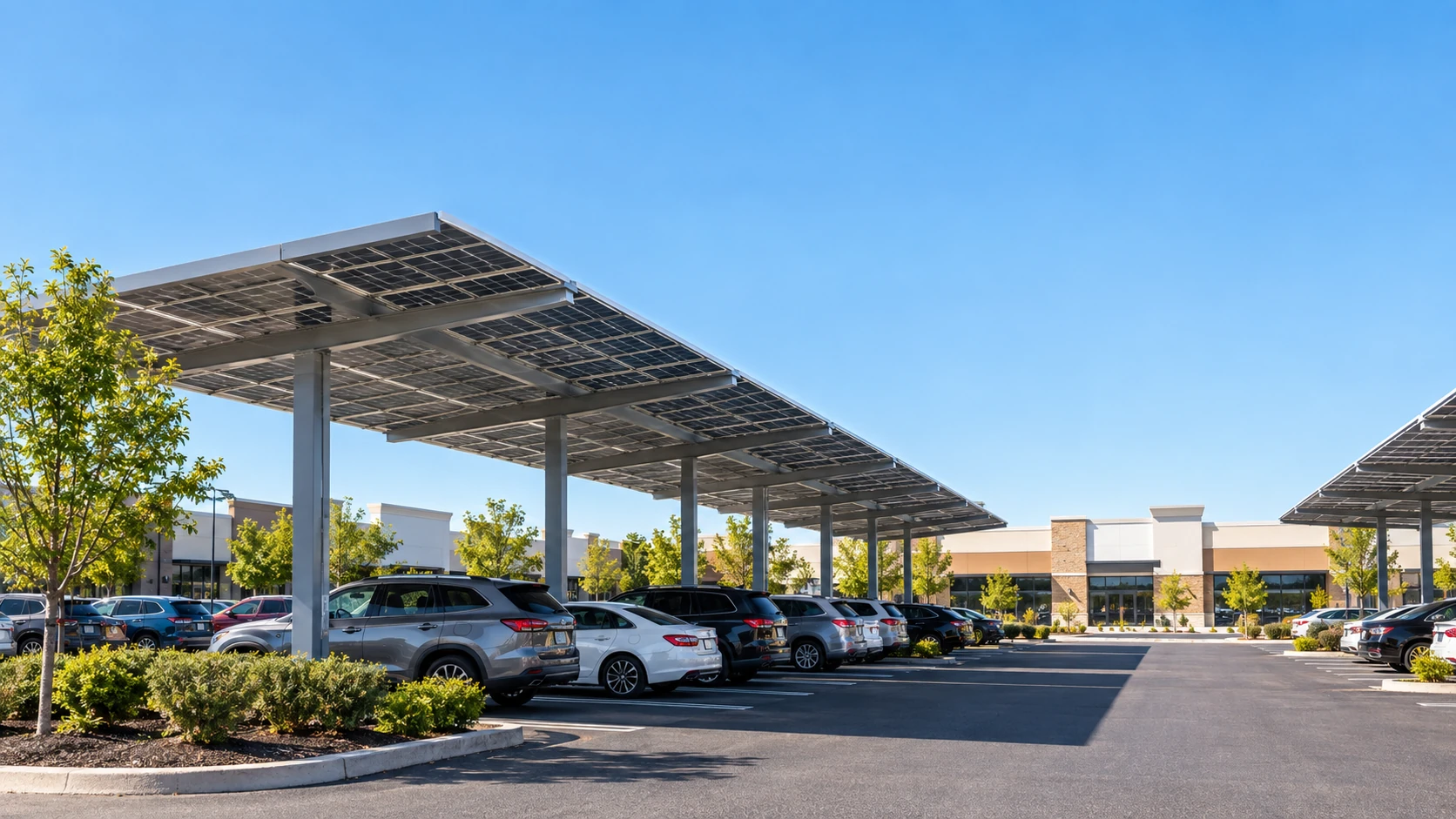
Our commercial solar team designs and installs rooftop systems, solar carports and parking canopies, ground-mounted systems, energy storage, and commercial EV charging for schools, retail centers, health care facilities, warehouses, offices, and hotels. Our process covers design and engineering, township permits, utility approvals, and SuSI registration. If your roof isn't strong enough for solar or risks future damage, we replace it before installing the panels. Every commercial system comes with thirty years of service and warranty protection, and we offer payment plans and financing options.
For a bigger-picture look, read our guide to commercial solar for NJ businesses.
Frequently asked questions
Is there still a commercial solar tax credit in 2026?Yes. The federal business credit (Section 48E) is still available, generally 30% for systems under 1 megawatt. Solar projects that begin construction after July 4, 2026 must be finished and running by December 31, 2027.
What does "placed in service" mean?It means the system is fully installed, permitted, tested, and ready to produce power. In New Jersey, that generally matches when the utility approves the system to operate.
Can a nonprofit or school get the solar tax credit?Yes, through elective pay, which turns the credit into a direct payment from the IRS. Larger projects (1 megawatt or more) starting in 2026 must meet U.S.-made content rules to avoid losing the payment.
Does the business solar credit apply to batteries?Yes, and battery storage has a longer runway. It isn't subject to the end-of-2027 solar deadline.
Can I combine the federal credit with New Jersey incentives?Yes. Commercial systems can generally claim the federal credit and also earn New Jersey SREC-IIs, plus the state sales and property tax exemptions.
Don't let the deadline decide for you
The credit is generous, but the calendar isn't. Request a free consultation and we'll look at your roof, parking lot, or land, and estimate your system so you and your tax advisor can run the numbers.
